WPA (Wi-Fi Protected Access)
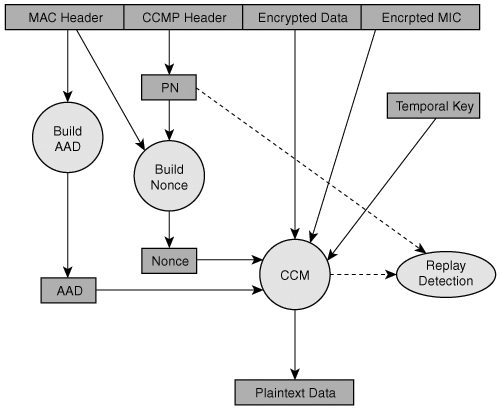
WPA (Wi-Fi Protected Access) is an interim standard by the WiFi Alliance to comply with the security protocol designed for wireless security. WPA will most likely be rolled into an eventual IEEE 802.11i standard. This protocol was an outcome of numerous severe flaws researchers had discovered in the preceding wireless security system called Wired Equivalent Privacy (WEP). WPA (W-Fi Protected Access) Modes of Operations WPA (Wi-Fi Protected Access) features two very different modes of operation: WPA Enterprise Mode WPA PSK (Pre-Shared Key) Mode Requires an authentication server Does not require an authentication server Uses RADIUS protocols for authentication and key [...]
Planning and Implementing an Authentication Solution
An Overview on Authentication Authentication is the process of identifying authorized valid users from unauthorized users. It is therefore the initial step in defining and implementing a network security strategy because it deals with restricting access to the network. A solid authentication solution prevents unauthorized users such as hackers, and Trojan horses from accessing network resources. Implementing the ideal authentication strategy for your network could be tricky because while too much authentication would keep unauthorized network access under control, it could also prevent authorized network users from legitimately accessing network resources. Authentication also opens the door to other security strategies [...]
How Internet Authentication Service (IAS) works
Internet Authentication Service (IAS) is Microsoft's implementation of a RADIUS (Remote Authentication Dial-in User Service) server and proxy. As a RADIUS server, IAS performs centralized connection authentication, authorization, and accounting for many types of network access, including wireless and VPN (Virtual Private Network) connections. As a RADIUS proxy, IAS forwards authentication and accounting messages to other RADIUS servers. The Authentication and Authorization Processes When a user tries to connect to a dial-up connection server or a Network Access Server (NAS)/Virtual Private Network (VPN) Server the following authentication requests are performed: When the clients has been connected successfully over PPP initially [...]
IS-54 and IS-136: TDMA
IS-54 and IS-136 are standards for TDMA American Digital Cellular. Mobile Frequency Range Rx: 869-894; Tx: 824-849 Multiple Access Method TDMA/FDM Duplex Method FDD Number of Channels 832 (3 users per channel) Channel Spacing 30Khz Modulation DQPSK Channel Bit Rate 48.6Kb IS-54 and IS-136: TDMA Security IS-54 and IS-136 use the CAVE (Cellular Authentication, Voice Privacy and Encryption) algorithm for authentication and the CMEA (Cellular Message Encryption Algorithm) for encryption. CAVE and CMEA are documented in Common Cryptographic Algorithms and Interface Specification for Common Cryptographic Algorithms. David Wagner, Bruce Schneier and John Kelsey published Cryptanalysis of the Cellular Message Encryption [...]