A potentiometer, called pot for short, is an electrical component that acts as a variable voltage divider. They usually have three terminals, one of which is connected to a moving center contact. A potentiometer with two terminals is a variable resistor, called a rheostat. Potentiometers come in many forms including rotaries, trimmers, sliders.
Potentiometer is also the term for an old instrument that measured an unknown voltage after being calibrated with a known voltage. These have been repla
[ read more ]
MCX is a type of connector developed in the 1980's and used in the microwave transmission range. It carries frequencies of up to 6 GHz and is the second smallest of the subminiature connector families. At approximately 30% smaller than Subminiature B connectors (measuring in at 0.140 inches on the outer diameter of the plug), MCX is designed to completely minimize any leakage at its joints.
The MCX connector is used with a standard coaxial cable and features a snap-on interface in which the c
[ read more ]
Standing Wave Ratio (SWR) meters are used to measure the standing wave ratio in a communications transmission line. The meter can display how much a transmission line and the load are mismatched (normally a radio antenna). It also determines how effective the impedance is of matching efforts. In CB and ham radio circles, the SWR meter is used to help determine how much RF energy is being reflected back to the transmitter compared to how much is being sent out during operation. If the amount of r
[ read more ]
The Ku band (Kurtz-under band) is primarily used for satellite communications, particularly for editing and broadcasting satellite television. This band is split into multiple segments broken down into geographical regions, as the ITU (International Telecommunication Union) determines.
The Ku band is a portion of the electromagnetic spectrum in the microwave range of frequencies ranging from 11.7 to 12.7GHz. (downlink frequencies) and 14 to 14.5GHz (uplink frequencies).
The most common Ku
[ read more ]
A weather satellite is a satellite which is used by meteorologists to gather information about the weather.
Weather satellites give meteorologists a view of weather patterns over a very large area. This enables meteorologists to track large weather patterns and make more accurate predictions of future weather behavior.
In addition to visual monitoring, weather satellites may also use thermal imaging, X-ray sensors, high-energy proton detectors, alpha detectors, and energetic particle s
[ read more ]
C Band is the original frequency allocation for communications satellites.
C-Band uses 3.7-4.2GHz for downlink and 5.925-6.425Ghz for uplink.
The lower frequencies that C Band uses perform better under adverse weather conditions than the Ku band or Ka band frequencies.
C Band Variants
Slight C Band frequency variations are approved for use in various parts of the world.
Band
TX Frequency
RX Frequency
Extended C Band
5.850 - 6.425 GHz
3.625 - 4.200 GHz
Super Extended
[ read more ]
Weather satellites are now operated by the United States, Japan, Europe, Russia, India, and China.
These weather satellites provide invaluable information to meterologists and climatologists. In addition, individuals all over the globe enjoy these fascinating pictures of the Earth from outer space.
Free Weather Satellite Images on the Web
The NOAA's Geostationary Satellite Server provides visibile light, infrared, and water vapor images of the Continental United States, Puerto Rico, and
[ read more ]
A phototransistor is a device that converts light energy into electric energy. Phototransistors are similar to photoresistors but produce both current and voltage, while photoresistors only produce current. This is because a phototransistor is made of a bipolar semiconductor and focuses the energy that is passed through it. Photons (light particles) activate phototransistors and are used in virtually all electronic devices that depend on light in some way.
How a Phototransistor Works
A photo
[ read more ]
An ultrasonic sensor is a device that works in much the same way as RADAR and SONAR. In fact, ultrasonic sensors mimic bats and other animals' natural ability to use ultrasonic frequencies for navigation. Ultrasonic sensors broadcast a powerful, ultrasonic frequency, then detect the ultrasonic sound waves as they bounce off of objects and return to the sensor. They are almost always used to measure speed or direction and are very efficient at determining position.
How Ultrasonic Sensors Work
[ read more ]
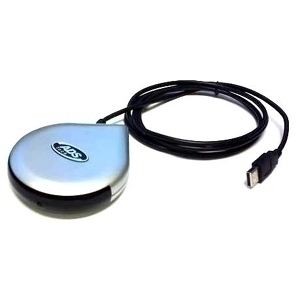
GPS stands for Global Positioning System. It refers to a system of satellites that constantly transmit a signal, and a GPS terminal that picks up those signals and calculates its position on Earth by measuring the distance between itself and two or more GPS satellites (by measuring the time it takes to receive the signals).
How to Use GPS
GPS operates using trilateration. Trilateration is the process of determining the position of an unknown point by measuring the lengths of the sides of
[ read more ]