Overclocking is the process making a computer component run at a higher speed than that specified by the manufacturer. The components that can be overclocked include the CPU, the memory and the video cards. Although there may be many different reasons for overclocking, the most common reason is to increase hardware performance. For example the AMD Athlon 2500+ processor which normally runs at a CPU clock speed of 1.83 GHz may me made to run at a clock speed of 2.20 GHz or the GeForce 6800 cards
[ read more ]
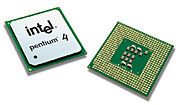
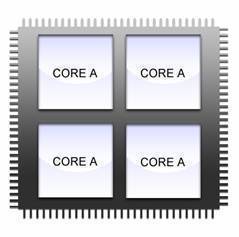
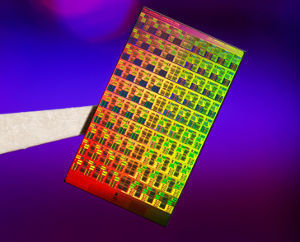
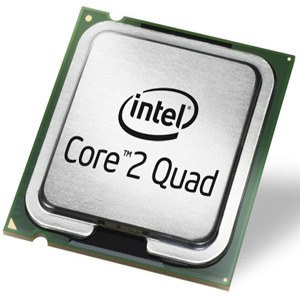
A quad core processor is a piece of hardware made up of three components. The first is the core, which in this case, there are four of them. Then these are bundled up and fit inside a die. The die is the silver tab you might see on your processor. Finally, this is added to the package which is the green material you see with all of the pins. This is your CPU; however, it is the individual cores that, when combined, make up the quad core processor.
For a quad core to work, it requires a very pre
[ read more ]
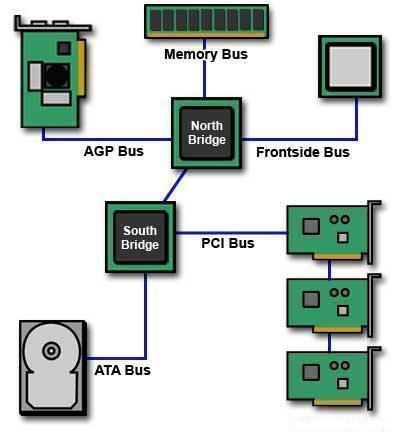
The Front Side Bus (FSB) is the connecting path between the CPU and other key components such as system memory.
The Front Side Bus is also called the Data Bus and the Processor Side Bus (PSB).
Front Side Bus Widths of Various CPUs
CPU
Front Side Bus Width
8088
8
8086
16
80286
16
80386SX
16
80386DX
32
80486
[ read more ]
Socket 754 is a 754-contact CPU socket used by some AMD Athlon and Sempron processors.
Socket-754 supports a 200MHz system clock and an 800Mhz HyperTransport link.
Socket-754 is similar to Socket-939, except that Socket-754 supports only one memory controller channel as opposed to the dual channels available on the Socket-939 and that the HyperTransport bus is 800MHz as opposed to 1000Mhz.
The Socket-754 is a Pin Grid Array (PGA) Zero Insertion Force (ZIF) socket.
A ZIF socket features a lev
[ read more ]
Athlon-64 is a name for AMD's main line of 64-bit CPUs.
The Athlon-64 line is designed to complete against the Intel Pentium CPUs.
Athlon-64 processors are designed to execute 32-bit and 64-bit instructions simultaneously. This enables them to directly address more than 4GB of RAM.
Athlon-64 CPUs feature an L1 cache with 64KB of RAM for data and 64KB of RAM for instructions.
The 1024KB L2 cache in an Athlon-64 CPU operates at the full speed of the CPU.
These L1 and L2 cache numbers are per
[ read more ]
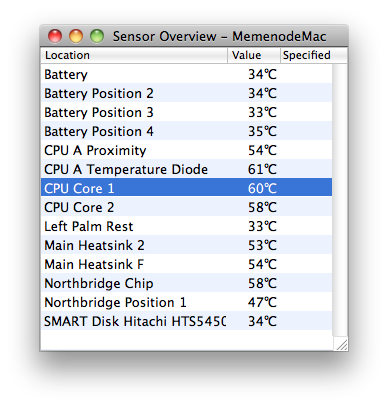
Excessive heat damages electronics. Monitoring CPU and other computer components' temperature help them run properly. To make the most of monitoring software, users must ensure that ACPI functionality is enabled in their motherboard BIOS.
Why CPU Temperature is so Important
When the first affordable PCs were offered to the general public in the early 80's, system engineers and designers took into consideration the heat that system components emitted and ensured that their case and cooling desi
[ read more ]
CPUs process data using instructions stored in the computer memory or RAM. The RAM is a temporary storage area that makes information and instructions available to the microprocessor, which does not have to use this information until required. The two processor classifications are the Reduced Instruction Set Computer (RISC) and the Complex Instruction Set Computer (CISC). The primary difference between the two is that a RISC-based chip uses more basic instruction sets to achieve a greater clock
[ read more ]
Socket 940 is a 940-contact CPU socket used by some AMD Opteron and Athlon 64 FX processors.
Socket-940 supports a 200MHz system clock and an 800Mhz HyperTransport link.
The Socket-940 is designed for use the registered error-correcting memory. The makes the Socket-940 extremely suitable for server-class machines.
The Socket-940 is a Pin Grid Array (PGA) Zero Insertion Force (ZIF) socket.
A ZIF socket features a lever on one side of the socket. When this lever is pulled up, the spring contac
[ read more ]
EM64T (Extended Memory 64 Technology), now known more commonly as Intel 64 or the x64 (that is when including AMD64 too), is a 64 bit superset/extensions that central processing units (CPUs) process. It is widely used in Intel's processors, including Pentium 4, Pentium D, Pentium Extreme Edition, Celeron D, Xeon, Pentium Dual Core, and Core 2 processors.
Originally codenamed Yamhill, the EM64T was first "announced" in 2004 when the Intel chairman at the time, Craig Barrett, announced that it
[ read more ]
Sempron is a name for AMD's line of lower-cost CPUs.
The Sempron line is designed to complete against the Intel Celeron lower-cost CPUs.
Sempron CPUs feature a L1 cache with 64KB of memory for data and another 64KB of memory for instructions.
The L2 cache on Sempron CPUs operates at the full speed of the CPU and ranges from 128KB to 512KB in size.
Sempron CPUs support MMX, 3DNow!, and SSE. Some models of Sempron CPUs also support SSE2.
Sempron CPUs are designed to fit Socket-A or Socke
[ read more ]