

A volcano is any opening in the Earth’s surface that allows molten rock and volcanic gases to escape from far below the Earth’s surface. Although many volcanoes are mountainous in shape, a volcano can exist in nearly any form, including volcanic vents on the ocean floor, ice volcanoes, which have been found on a variety of other planets, and volcanoes that are simply a crater in the ground.
Despite the variances in the shape of volcanoes, they all erupt in relatively the same way. The process begins when the pressure on a magma chamber deep below the Earth’s surface begins to build up. This building pressure causes the magma from the chamber to be forced upward through a series of tubes or conduits. As the magma reaches the surface, it is thrust through the vents on the volcano, resulting in an eruption.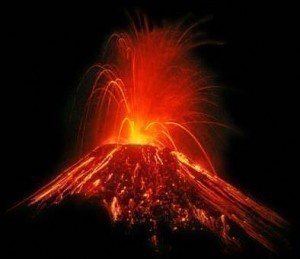
The size and severity of a volcanic eruption depend on a variety of underlying factors. Some of these include:
- How full the magma chamber was at the time of the eruption
- The amount of gas present in the magma and in the magma chamber itself
- How much silica is in the magma itself
- Whether or not any water is present in the eruption
Water, Silica, and Pumice
If a volcanic eruption has a low amount of water as well as a low amount of silica in the magma, the lava will flow gracefully from the volcano. This is because there is little water to provide any explosive potential and the lack of silica in the magma causes the lava to be runny and more liquid. Under the same conditions, if the magma were to have a higher amount of silica, the lava would become pasty and would work more towards making the volcano taller and create what is known as a lava dome atop the volcano.
If there are high amounts of water present in a volcanic eruption, the volcano changes its eruption style significantly. The added water creates steam, which can lead to fountains of lava if there is not much silica present in the magma or an explosion if the magma erupting from the earth is high in silica.
Despite the powerful forces at work during a volcanic eruption, there are a few things that can block a volcano from erupting. One such obstacle is an accumulation of pumice, which can create a massive stoppage in the magma pipes. However, once the magma finally breaks through its barrier, an explosion type eruption usually takes place.
BUDDERLANDIA
Budder
BUDDERLANDIA
Hhahaha
hi
volcanoes erupt because of the magma rising through the vent!!!!! hope this helps guys!
hi
yh
Amanda
They exist because the magma in the ground form the volcano. When it explodes, the lava dries on the volcano and the volcano gets bigger over time from the dried lava.
Amanda
Volcanoes explode due to the amount of pressure from the magma. The volcano explodes when there is no more room for the magma. When the volcano explodes the magma turns into lava.
jeumil
volcanoes erupt because of the magma inside it and when the magma is near to the top it turns to lava and then it pop’s out like a soda 😀
jim
this wasn’t verrry helpful but cheers anyway
nisi
i’m intrested in2 studying volcanoes <(“)
jeumil
um me i like learning about the planets in space not volcanoes ehehe
arianna
the volcano erupts every thousnad years
Berna
Y Do Volcanoes Exist Ffs? :@ .
bella
can i asked someone about a volcano plz describe the parts of a volcano
nigjlu
gjhhkhhkhhhj
huntyr
volanoes are always thought of big mountians with a hole on top like a f***ing rock!!!!
bella
hi my name is bella and iam 14/15 yr old i like werewolve because they are fast animals on this planet and also iam a female what are you male or female
sarah
how many times a year do volcanos erupt?
how do volcanos effect people?
why do volcanos erupt?
kylita
volcanoes are really cool but hot
jim
well noo ?
charlotte
volcanos arent cool there hot
Mormon
But how do magnets work?!
anamika
i thought volcanoes was the topic 😛
thepussydestroyer c;
i know c; so how you been ?
ted
volcanos are cool!
memenode
Actually, they are very very hot. 😉
Isha Daukia
how do they form the lava?
jeumil
First magma and then lava read my comment below 😀