RSS Feed

Microsoft DHCP

Understanding DHCP

Understanding DHCP

DHCP Overview
An IP address can be defined as a unique numeric identifier (address) that is assigned to each computer operating in a TCP/IP based network. Manually configuring computers with IP addresses and other TCP/IP configuration parameters is not an intricate task.

Securing DHCP Servers

Securing DHCP Servers

The DHCP server role is responsible for dynamically assigning IP addresses to DHCP clients, and for assigning additional TCP/IP configuration information to DHCP clients as well.

Monitoring and Troubleshooting the DHCP Server

Monitoring and Troubleshooting the DHCP Server

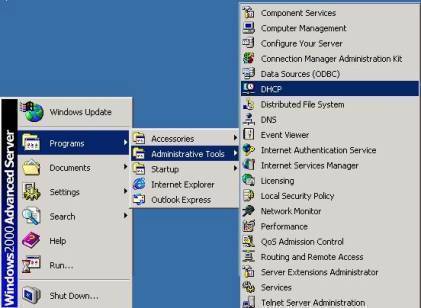
Users can use the Event Viewer tool in the Administrative Tools folder to monitor DHCP activity. Event Viewer stores events that are logged into the system log, application log, and security log. The system log contains events that are associated with the operating system.

DHCP Leasing

DHCP Leasing

An Overview of DHCP
In TCP/IP based networks, a unique IP address must be assigned to each computer. An IP address is a unique numeric identifier that identifies computers on the network. The Dynamic Host Configuration Protocol (DHCP) is a service that can be implemented to automatically assign unique IP addresses to DHCP clients.

DHCP and Remote Access

DHCP and Remote Access

DHCP and Remote Access Overview
When a remote computer connects to a remote access server (RRAS), it is automatically provided with an IP address when the Point-to-Point Protocol (PPP) connection is established.

Managing the DHCP Server

Managing the DHCP Server

Management Tasks for the DHCP Server
The common management tasks that you need to perform for your DHCP servers are listed below:

Delegate DHCPadministration to individuals.
View and analyze DHCPstatistical information.
Change the status of the DHCP service.
Configure superscopeadministration entities.
Back up the DHCPserver database.

Configuring DHCP

Configuring DHCP

Configuring the DHCP Server Environment
The primary steps required for configuring and managing your DHCP server environment are:

Install the DHCP service on a server.
Authorize the DHCP server in Active Directory.
Configure the necessary DHCP scopes for your subnets.
Configure superscopes and multicast scopes.
Configure the DHCP lease duration.

DHCP Relay Agents

DHCP Relay Agents

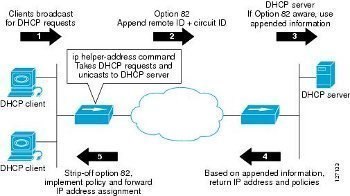
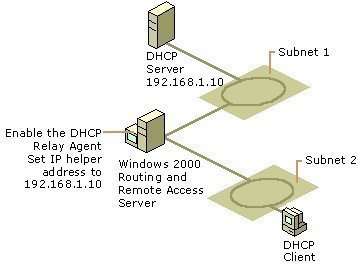
The Dynamic Host Configuration Protocol (DHCP) is a service that runs at the application layer of the TCP/IP protocol stack to dynamically assign IP addresses to DHCP clients, and to allocate TCP/IP configuration information to DHCP clients.