RSS Feed

Microsoft Exchange

Understanding Outlook Web Access Client

Understanding Outlook Web Access Client

New features in Outlook Web Access (OWA) 2003
Outlook Web Access (OWA) is used to send and receive e-mail through the Web. Outlook Web Access 2003 includes different levels of feature availability or user modes. Some OWA 2003 features are only available in premium mode.

Troubleshooting Exchange Server 2003

Troubleshooting Exchange Server 2003

Troubleshooting Exchange Server 2003 Installation
A few reasons for an Exchange Server 2003 installation failing are listed here:

The permissions being used for the installation are incorrect: To install Exchange Server 2003, the following permissions are needed:

To initially run ForestPrep in a forest to update/extend the Active Directory schema

Restoring Exchange Server 2003

Restoring Exchange Server 2003

Documenting your Exchange Server 2003 Environment
To successfully restore or recover any aspect of your Exchange Server 2003 environment, it is important that you document the following:

The Exchange Server 2003 environment.
The backup process.
The recovery process.

Planning an Exchange Server 2003 Infrastructure

Planning an Exchange Server 2003 Infrastructure

Understanding the Different Combinations of Exchange and Windows Server
The different supported combinations of Exchange and Windows Server are listed here:

Exchange Server 5.5 is supported on the following Windows versions:

Windows NT 4 Server.
Windows 2000 Server.

Securing Exchange Server 2003

Securing Exchange Server 2003

Understanding Digital Signatures
You can through digital signatures secure an Exchange Server 2003 messaging system. Digital signatures are used to verify the identities of the senders of data messages.

Exchange Server 2003 Overview

Exchange Server 2003 Overview

Understanding the Different Messaging Systems
With shared-file messaging systems, directories and files typically reside on a file server. The structure of directories and files at the centralized file server location are commonly called post offices. The post office is the mail store for many users.

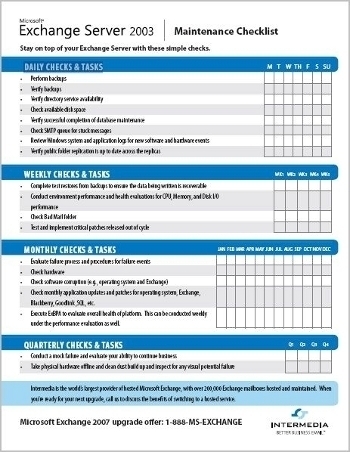
Exchange Server 2003 Maintenance and Management Activities

Exchange Server 2003 Maintenance and Management Activities

Managing the Different Server Roles
The different roles that can be configured for Exchange Server 2003 are listed here:

Mailbox Store server (back-end server): The mailbox store server is mainly responsible for the following functions:

Storing of messages of mail-enabled users.
Storing attachments.
Storing files and folders.

Exchange Server 2003 Data Storage and Management

Exchange Server 2003 Data Storage and Management

Understanding Exchange Server 2003 Data Storage
Exchange Server 2003 uses the Extensible Storage Engine (ESE) database structure to store data. Data can be stored separately for messages and for transactions:

Messages are stored in.edb and .stm database files.

Migrating from Exchange 5.5 to Exchange Server 2003

Migrating from Exchange 5.5 to Exchange Server 2003

Differences between Exchange 5.5 and Exchange Server 2003 Environments
Exchange version 5.5 worked well in smaller organizations. Exchange 5.5 deployments typically consisted of Exchange servers being at each remote location, and with no more than thirty users.
The main Exchange 5.

Migrating from Exchange 2000 Server to Exchange Server 2003

Migrating from Exchange 2000 Server to Exchange Server 2003

Preparing for Migration to Exchange Server 2003
For number of services running in existing Exchange 2000 environments, you first have to move these services to other servers, and then remove the services so that the upgrade to Exchange Server 2003 can occur.