Securing the Network
When planning for and implementing network security, the activities which you should be performing would typically involve the following:
Planning how the network infrastructure will be secured from both internal and external threats.
Defining and creating internal and external security boundaries.
Implementing network security technologies and mechanisms that can assist the organization in meeting its security requirements.
Implementing serve
[ read more ]
IPSec Policies Overview
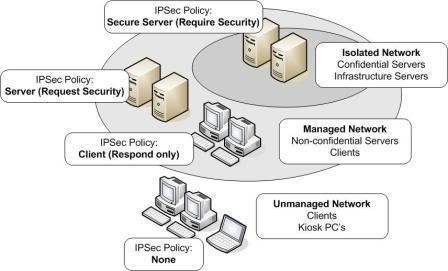
IPSec encrypts data information contained in IP datagrams through encapsulation to provide data integrity, data confidentiality, data origin authentication, and replay protection. The two main IPSec components that are installed when you install IPSec are the IPSec Policy Agent and the IPSec driver. The IPSec Policy Agent is a service running on a Windows Server 2003 computer that accesses IPSec policy information. The IPSec Policy Agent accesses the IPSec policy infor
[ read more ]
IPSec Review
IPSec is a framework of open standards for encrypting TCP/IP traffic within networking environments. IPSec works by encrypting the information contained in IP datagrams through encapsulating to provide data integrity, data confidentiality, data origin authentication, and replay protection.
IPSec uses cryptography to provide authentication, data integrity, and data confidentiality services. Authentication deals with verifying the identity of the computer sending the data, or th
[ read more ]
Using the IP Security Monitor Snap-In to Monitor IPSec
The IP Security Monitor snap-in, a new feature in Windows Server 2003, can be used to monitor and troubleshoot IPSec activity. The IP Security Monitor snap-in provides enhanced IPSec security monitoring. As long as the IPSec policy is active, you can monitor how the IPSec policy is functioning within your networking environment through the IP Security Monitor.
The main administrative activities which you can perform through the IP Secu
[ read more ]