

MTBF stands for Mean Time Between Failures.
MTBF numbers represent a statistical approximation of how long a set of devices should last before failure. MTBF numbers are not valuable at determining when a specific device will fail. MTBF numbers are usually stated in terms of hours.
MTBF is often erroneously described as Mean Time Before Failure.
Environmental Factors and MTBF
MTBF numbers can be radically altered by environmental factors such as improper power and cooling. MTBF numbers can also be lowered by excessive vibration or by many forms of misuse.
For example, hard drives installed in notebook PC’s have lower actual MTBF’s than hard drives in desktop PC’s due to environmental factors.
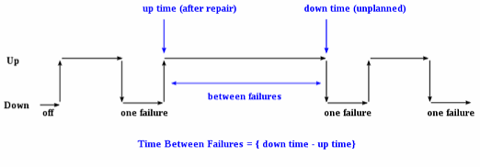
Defining Time in MTBF
The Time utilized in MTBF may not be actual clock time, it may be the time during which the system is actually in use.
A machine which is operated 8 hours a day may last three times as long as an identical machine which is operated 24 hours a day. The MTBF for these machines would be the same, because they both experienced the same number of in-serice hours.
The MTBF Curve
In the real world, MTBF numbers are not steady over the lifetime of a set of devices.
Systems tend to experience a high failure rate during an initial burn-in period. During this period, manufacturing defects lead to a large number of early system failures.
During the operational lifespan of a set of devices, the MTBF numbers improve. Failures become much more rare, as the systems experiencing early failure have been repaired or replaced.
Eventually, the devices will begin to wear out. MTBF numbers will steadily grow worse until the devices are replaced with new equipment.
Calculating MTBF
When a product has an estimated MTBF of one million hours, that does not mean that the product was tested for one million hours. MTBF numbers are generally created by estimating the MTBF of individual components and by past experience with similar products.
MTBF numbers can be generated for a datacenter or IT shop by looking at a historical record of service outages.


GAUTHAM KAMATH
SIR,
I dont know how to caalculate MTBF, PLEASE GUIDE ME
I HAVE SUM ELECTRICAL & MECHANICALS COMPONENTS LIKE: MCB, BLOWERS, SURGE PROTECTOR, PLC, PRESSURE SENSOR, RESISTIVITY CONTROLLER & SENSOR, TEMP. SENSOR.
IN THIS WHICH TECHNICAL SPECIFICATION REQUIRED FOR DO THE MTBF CALCULATION.
GAUTHAM KAMATH
9538409674
Sachin Balkundikar
Sir,
I have a data for calculating MTBF ..Please guide us for calculating MTBF. for every month. Please share the regarding information.
vksharma
I work in a plant that has 11 plastic injection moulding machines. I calculate individual machine MTBFs. How do you calculate overall plant level MTBF (all 11 machines)?