

A linear particle accelerator is a large device that can speed up electrons, ions, or other particles and slam them into a target in order to release subatomic particles and radiation. Sensors then record these by-products, send their data to a central computer system that creates a digital, 3D image of the particle, and labels its specific chemical and physical attributes. Linear particle accelerators differ from circular particle accelerators only in that linear ones speed up particles in a straight, narrow path while circular ones use a large, circular path. Both types are often over 1 mile long and are usually built underground.
How Linear Particle Accelerators Work
Linear particle accelerators use a long, narrow track made of copper and magnetic fields to direct a particle in a straight line until it builds up a large amount of energy. The particle then collides into a target that is placed in its path and releases both subatomic particles and radiation. Linear and circular particle accelerators are sometimes used in conjunction with each other to further increase the particle’s speed, usually resulting in speeds approaching the speed of light.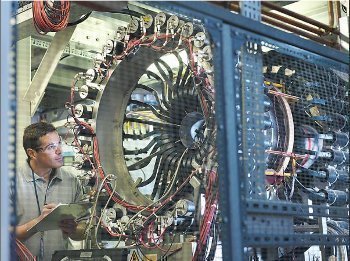
Applications
Particle accelerators are most often used to analyze particles and observe their physical composition. They are much more common than that, however, as cathode-ray tubes are often used inside of televisions and computer monitors. In this case, an electron is used as a particle and a large magnet inside of a vacuum speeds it up. The electron is then collided with the inside of the screen, which is covered in dyed phosphor. The impact releases energy and causes a light to appear on the opposite side of the screen.
Advantages
A linear particle accelerator’s main advantage is that it is capable of accelerating electrons and other particles to extremely high velocities. Because linear particle accelerators are built underground, they do not pose a threat to nearby infrastructure nor give nearby pedestrians health problems. They can accelerate particles much faster than circular particle accelerators and have a high mass output, making them ideal for antimatter production. Linear particle accelerators can also be shut off when not in use and do not require any significant shielding.
Disadvantages
While linear particle accelerators are generally safe for the environment and nearby people, they do produce radiation. However, these radiation levels are usually low enough to not incite any significant problems. Linear particle accelerators must also be activated in short bursts rather than a continuous stream of particles as they quickly convert the electrons into heat when left to do so. Additionally, linear particle accelerators can induce radiation in its metal parts, creating a secondary power source even while the power is shut off. This, of course, requires additional shielding.


Follow Us!