

Subatomic particles are the most elementary particles found in nature. The three basic subatomic particles that comprise an atom are protons, electrons, and neutrons. The historical definition of a subatomic particle was expanded over the past several decades to include elementary particles that are less complex than an atom and cannot be broken down further. The modern definition of subatomic particles breaks all of them down into either leptons or quarks.
Subatomic Particles that Make up an Atom
Electron
The electron was the first subatomic particle discovered in 1896. U.K. Physicist JJ Thomson made the discovery while he was conducting an experiment with cathode rays. After determining the electron’s mass and charge, it was determined that they make up 0.06% of an atom’s mass. The electron’s mass is considered negligible and the elementary charge (negative) and angular momentum are constant. The electron has a magnetic field while in motion and absorbs and radiates energy in the form of a photon. It is also responsible for chemical bond formation between two or more elements through the exchange or sharing of electrons.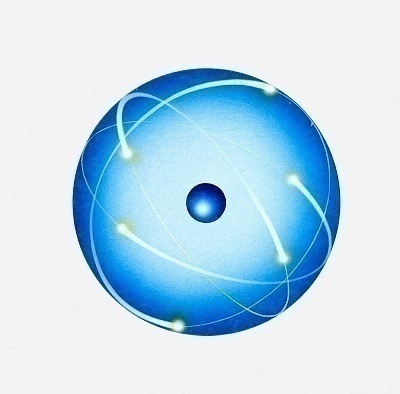
Proton
Ernest Rutherford discovered the proton in 1918 while conducting an experiment where he took alpha particles and bombarded nitrogen gas with them. The particles have a positive charge and help to form an atom’s nucleus when combined with a neutron. The proton is one of the most stable sub-atomic particles and helps to determine the identity of an atomic element.
Neutron
The neutron and proton form an atom’s nucleus. James Chadwick discovered the neutron in 1932. Neutrons have no natural charge and their mass slightly exceeds the proton’s. An atomic element’s isotope is determined by the total amount of neutrons in the nucleus. When a neutron is in a free state, it undergoes a rapid beta decay and has a lifespan of less than 15 minutes.
Other Subatomic Particles
When scientists started using particle accelerators in the 1950s and 1960s, a significant number of particles were discovered that were actually smaller than the three basic sub-atomic ones previously acknowledged with the proton, electron, and neutron. These particles include fermions, hadrons, bosons, leptons, and quarks.
Fermions
Fermions are subatomic particles that comprise known matter and anti-matter.
Leptons
These are basic particles that do not help hold an atom’s nucleus together and are found in known matter. The electron and neutrino are examples of these particles.
Quarks
A quark is a basic particle that does not help hold an atom’s nucleus together. Quarks are extremely small, are classified by the type and amount of charge that they hold, and are the most fundamental particles discovered to date.
Hadrons
Composite particles such as the proton or neutron.
Bosons
These are particles that carry forces.
Leptons
A lepton is extremely small and has no known structure or size. The electron and neutrino are examples of leptons, which are further classified into: tau-tau neutrino, muon-muon neutrino, and the electron-electron neutrino.

Follow Us!