

eSATA stands for External Serial Advanced Technology Attachment. It is meant to be an external interface for SATA technologies. SATA or Serial ATA (Advanced Technology Attachment) is the next generation of drive interfaces, its predecessor being the Parallel ATA (PATA).
PATA
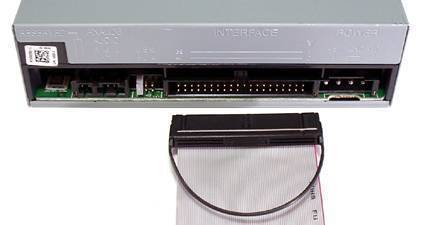
Anyone who has opened up their computer must have noticed the flat, 40-wire parallel cables that are used to connect the hard disk, CDROM and other devices to their respective controllers; these are typical PATA connections. PATA has been the standard in connectivity for a while and served the purpose well, except for a few limitations.
1. Cables are limited to 18 inches (46 cm) in length.
2. Limited length results in congested cases with no air flow and inefficient cooling.
3. The maximum parallel transfer rate that the most advanced PATA drives can achieve is 133 Mbps.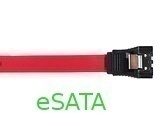
SATA
Serial ATA eliminated many of the shortcomings of its predecessor. It consisted of thin cables with tiny 7-pin connectors, which could have a length of up to 3 feet (1 meter). Being much thinner than PATA cables, they can be easily routed to ensure maximum airflow within the case. SATA also consumes less power (250 mV) compared to PATA (5 V). It also adds a few more goodies to the mix:
1. SATA eliminates the need for Master/Slave configurations and drive jumpers.
2. Setup is a much simpler process compared to PATA
3. SATA allows hot swapping – removal/addition of drives while the computer is running.
external SATA
With the introduction of eSATA, the power of SATA expands to include external storage solutions. eSATA’s direct competitors in data transfer for external storage devices are Firewire 400 and USB 2.0 (Universal Storage Bus). Unlike the other two, eSATA does not have the added overhead of translating data between the interface and the computer; this increases speed, conserves processor resources and eliminates the need for an off-load chip. It is capable of reaching thrice the data transfer rates of USB 2.0 and Firewire 400, making it an excellent choice for external disk storage. The only drawback that accompanies an eSATA connection is that unlike other competing technologies, it needs its own dedicated power connector.
eSATA Connectivity Options
If the motherboard does not come with an inbuilt eSATA connector, a PCI (Peripheral Component Interconnect) can be installed in an available PCI slot, which will act as an eSATA interface. If it is a notebook, depending on the model there are numerous external eSATA device options available to suit MCIA, PC Card, or ExpressCard slots.
When purchasing a new eSATA controller/bus card, care should be taken to ensure that it supports the particular SATA standard that is applicable to the SATA hard drive(s) in use. Usually with this technology, hardware supporting newer standards will be backward-compatible with legacy versions, but the reverse is not true.
Kevin McNeill
I just purchased a laptop with an “eSATA combo drive.” Is it compatible with USB 3.0 devices? Also, I have an external DVD that uses two USB slots (one for power supply I think). Is it safe to use the eSATA port for this drive? What about USB Hubs (4-1 & 7-1)? Thanks!
Colin Kee
HI =) There is a new eSATA + USB combo port call eSATAp.
How is it different from eSATA?
1) It can now power up a 2.5″ HDD/SSD without separate power supply.
On a desktop, it can even power up a 3.5″ HDD/SSD.
2) It is now backward compatible with USB 2.0
3) It can be safely add/remove with a freeware call hotswap!
4) Implementation simply requires a Delock desktop bracket. ZERO driver, no need to change BIOS to AHCI / registry tweak.
5) It is now found in almost 40% of the notebooks.
Fusioncat
eSATAp Support Group