

A volcano is typically found where two or more tectonic plates are either converging or diverging. The result is a rupture in the surface of the planet which then allows hot ashes, gas, and volcanic lava to rise up from the magma chamber located underneath the Earth’s surface to the atmosphere. Some of the common areas in the world that produce volcanoes include the Mid-Atlantic Ridge, the Pacific Ring of Fire, and the Rio Grande Rift in North America. Volcanoes also occur where there is thinning or stretching of the Earth’s crust. A question that regularly gets asked in schools and other educational settings is what causes volcanoes?
What are the Hazards of Volcanoes?
When a volcano erupts, there are a number of hazards that result from the event. First, the level of destruction in the immediate area of the volcano can be significant depending on the amount of lava and ash that results from the eruption. The ash can also pose a threat to aircraft a large distance away from the physical location of the volcano. Jet engines are particularly susceptible to having the volcanic ash sticking to the turbine blades of the engine. This results in the blade shape getting altered which can disrupt the operation of the engine and potentially cause the aircraft to crash. Additionally, if there is a significant amount of volcanic ash created from an eruption, the temperature in the affected area can be lowered causing a volcanic winter. This effect from volcanic ash can result in famine and death if it impacts areas that are used for growing and producing food.
How Do Plate Tectonics Work?
Plate tectonics play a significant role in the formation of volcanoes on the Earth’s surface. Volcanoes can either be formed by tectonic plates moving away or towards each other. When plates move away from each other such as at the mid-oceanic ridges, the phenomena is referred to as being a divergent plate boundary. As the plates move, new crust is formed by molten lava moving up to the Earth’s surface which then cools and solidifies. The resulting crust is extremely thin and results in adiabatic expansion. When the ridge between plates occurs above sea-level, the end-result is a volcanic island. When it occurs beneath the ocean, a submarine volcanic effect occurs resulting in a new seafloor crust being formed.
How do Convergent Tectonic Boundaries Work?
When continental and oceanic tectonic plates collide with each other, it results in a convergent plate boundary. The oceanic plate will submerge beneath the continental plate and form a deep ocean trench. The water released from the plate going beneath the continental plate will lower the melting temperature of the mantle wedge. This results in magma being produced which will commonly cool at depth in the ocean. When the magma does reach the surface of the ocean, it will create a volcano. Some good examples of this phenomena occurring are the Pacific Ring of Fire as well as Mount Etna.
What is a Volcanic Hotspot?
Scientists commonly use the “Hotspot” name for volcanic areas that are formed by mantle plumes. They are made up of a column of hot magma and other material that rises to the Earth’s surface from the boundary layer of the Earth’s core and mantle. This area will be very hot and create a large amount of melting of the mantle / crust. Since the hotspot is not a result of multiple tectonic plates meeting each other, the resulting volcano will go dormant as the plate covers the hotspot. The Hawaiian Islands were formed in this manner as well as the Yellowstone Caldera (supposedly).
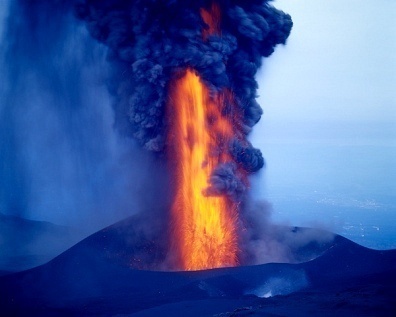
What are the Features of Volcanoes?
The classic view of a volcano is of the classic mountain shape that starts to erupt from the top of the land mass and has a large crater towards the summit. Although this is a commonly encountered volcanic feature, it describes only one of the numerous types of volcano found on the Earth’s surface. A number of the planet’s volcanoes have a rugged peak that is created by a lava dome vice a summit crater. Other types of volcanoes include extremely large plateaus that also have vents which are capable of allowing volcanic steam, gas, or even magma to escape to the Earth’s surface. Other types of volcanic structures that have been discovered include ones comprised of mud and ice.
Volcanic Fissure Vents
A volcanic fissure vent is a linear crack in the Earth’s surface that allows lava and ash to escape to the Earth’s surface. The eruptions that occur through these vents occur without the traditional “explosion” that normally occurs with a volcanic eruption. Vents can range in size from a few yards or meters up to several miles or kilometers. Fissure vents volcanoes are hard to identify until they have seen a significant lava flow. Many times, extremely narrow fissures have been known to fill with lava that hardens. Fissure vents are normally found in rift zones as seen in East Africa and Iceland and can also be seen on shield volcanoes.
What is a Shield Volcano?
Shield volcanoes get their nae from having a wide, “shield-like” geographic profile. They are created by the eruption of lava consisting of a low viscosity that is capable of flowing a large distance from a vent in the Earth’s surface. Shield volcanoes will not normally explode, and they are more commonly encountered in oceanic settings. The Hawaiian islands are an example of a number of shield volcanic cones in addition to those encountered in Iceland.
What is a Cryptodome?
A cryptodome is created when lava is able to force its way vertically through the Earth’s crust and results in a bulge. The Mt. St. Helens eruption in 1980 in the United States is an example of a cryptodome eruption. In this case, the lava was under enormous pressure and forced a bulge in the mountain that was also unstable. The bulge erupted and ultimately slid down the north side of the mountain.
Lava Domes
A lava dome is created through the slow to very slow eruption of lava that is extremely viscous. Sometimes, domes can be created inside a crater of a previous volcanic eruption; however, they have also been found to have been formed independently. Similar to a stratovolcano, lava domes are capable of producing very explosive eruptions, but the lava does not flow very far from the original vent of the volcano.
What are Volcanic Cones?
A volcanic cone can also be referred to as a cinder cone. They typically result from eruptions of smaller pieces of pyroclastics and scoria which are very similar to cinders. This close resemblance gives rise to the nick-name of cinder cones for the volcanic structure. Eruptions of this type of volcano are normally short in duration and result in cones that are between 50 and 600 yards in height. A cinder cone will normally only erupt once in their life. Some well-known examples of volcanic cones include Sunset Crater in Arizona, Paricutin in Mexico, and Caja del Rio located in New Mexico that is actually a field consisting of more than 60 volcanic cones.
Composite Volcanoes (Stratovolcanoes)
A composite volcano is a tall mountain that is conical in shape. The structure is made up of both lava flows as well as other matter ejected from the Earth’s mantle. The laval and other matter alternate and are created from the materials ejected from different types of volcanic eruption with give rise to the name of the volcano. Typically, the composition of the volcano will alternate between ash, cinder, and lava which are piled on top of one another and then harden. Some examples of this type of volcano include Mount Vesuvius located in Italy, Mt. Fuji located in Japan, and the Mayon Volcano located in the Philippines.
Supervolcanoes
A supervolcano normally consists of a large caldera and has the capability of inflicting significant damage on the surround area and sometimes across an entire continent. Due to the volume of ash and sulfur produced during the eruption of a super volcano, there can actually be a large impact on global temperatures for a period of several years after the eruption. They are considered one of the most dangerous types of volcano. Some examples of supervolcanoes found throughout the world include: the Ngorogoro Crater in Tanzania, Krakatoa near Sumatra, Indonesia, Lake Taup in New Zealand, and the Yellowstone Caldera located in Yellowstone National Park in the United States.
What are Submarine Volcanoes?
A submarine volcano is normally found on the ocean floor at varying depths of water. When one is located in shallow water, it can be seen from the surface from the blasting of both debris and steam above the ocean’s surface. Some of these volcanoes are located at great depths in the ocean water and may not create any disturbance on the ocean’s surface when erupting. Sometimes a submarine volcano may become large enough to become an island and typically produce “pillow” lava. Another common trait of this type of volcanic formation is the presence of hydrothermal vents located near the geologic formation.
Subglacial Volcanoes
A subglacial volcano develops underneath icecaps on the earth. They consist of flat lava which is located towards the upper portion of pillow lava flows. Once the iceap melts, the lava on the top of the formation collapse which then leave behind a flat-surfaced mountain. This type of volcano is also referred to as a table mountain or moberg. Iceland has a number of examples of this type of volcano in addition to a number located in British Columbia.
What is a Mud Volcano?
A mud volcano can reach heights of more than 700 meters and can be up to 10 km or more in diameter. They are created by liquids and gases that are excreted in volcanic active areas and are commonly associated with subduction zones. The largest known mud volcano is located in Indonesia which is 2,300 ft in height and six miles in diameter. Most of the gas excreted by mud volcanoes is methane with a mix of nitrogen and carbon dioxide. When these volcanoes excrete fluids, they will commonly include a mix of acidy or salty fluids along with hydrocarbons.
How are Volcanoes Classified?
There are a number of ways to classify volcanoes. These methods include the frequency that a volcano erupts, the shape of the volcano, and the method that the magma and ash erupts. The following are some of the common ways used to classify volcanoes today.
Active Volcanoes
There is not a consistent definition or standard for declaring that a volcano is active amongst volcanologists. A volcano’s lifespan can range from simply a few months to several million years or more which makes the label of being active even more difficult. As a result, a volcano can still be capable of seeing activity even if the last instance of an eruption has been several hundred or thousand years ago.
The current standard for activity is if a volcano has erupted in the past 10,000 years it is considered active. There are approximately 1,500 active volcanoes on the Earth with approximately 50 that erupt annually. There are an estimated 500 million people who live in locations that are near volcanoes which might erupt.
Earth’s Most Active Volcanoes
At the time of this writing, the following are some of the most active volcanoes on Earth:
Kilauea – Located on the Big Island of Hawaii, Kilauea has been erupting uninterrupted for 30 years (since January 3rd, 1983). Classified as a shield volcano, it is the youngest volcano on the Big Island.
Mount Etna – Mount Etna is located in Sicily and is one of the most active volcanoes in the world. It is located above the convergent plate margin of the Eurasian and African Plates. It is the tallest active volcano in Europe and continues to increase in height!
Mount Stromboli – Mount Stromboli is located in the Tyrrhenian Sea north of Sicily on Stromboli Island. It is one of three active volcanoes located in Italy and is also one of the eight Aeolian Islands. The volcano is constantly active with the lava being visible as far away as the Italian mainland giving it the nickname of the “Lighthouse of the Mediterranean.”
Santa Maria Volcano – Santa Maria Volcano is located in Guatemala near Quetzaltenango. The volcano’s eruption that occurred in 1902 is now considered to be one of the four largest eruptions of the 1900s and one of the top five in the past two to three hundred years. The Santa Maria volcano is part of the Sierra Madre volcano range and first started erupting approximately 30,000 years ago.
Mount Yasur – Mount Yasur is located on Tanna Island, Vanuatu and rises approximately 1,184 feet above sea level. It is located near Sulphur Bay and has a circular summit crater that is 400 meters in diameter. The volcano is a stratovolcano which is caused by the Indo-Australian Plate being subducted beneath the Pacific Plate. It has seen eruptions for approximately 800 years and supposedly attracted Captain James Cook to visit the island in 1774.
Other active volcanoes located around the earth include:
Sangay,Mount Nyiragongo and Mount Nyamuragira in Africa, Piton de la Fournaise, in Réunion, Erta Ale, in the Afar Triangle, Mount Erebus, in Antarctica, Mount Merapi, Ol Doinyo Lengai, Ambrym, Pacaya, Arenal Volcano, Sheveluch, and Klyuchevskaya Sopka.
ananya
what are the manmade and natural causes of volcanoes