

Body armor has been in use by military forces since the early middle ages. Armor of metal, leather, cloth padding, silk and other plant material has been intrinsic to military actions since that time. The bullet proof vest, however, is a more recent invention with the specific design intent of protecting its wearer from firearm projectiles. Modern firearm projectiles proved to be difficult to stop due to the new materials of manufacture, high velocities, and rate of fire increases.
Although individuals have been creating and utilizing makeshift means to protect themselves from bullets for some time beforehand, Casimir Zeglen of Chicago Illinois is credited with producing the first commercial bullet proof vest available to the public starting in the late 1800s. Zeglen's vests were made of silk fabric based on the findings of Dr. George Goodfellow of Arizona. Dr. Goodfellow observed that the silk cloth of a handkerchief slowed bullet velocities and penetration capabilities when inspecting bodies after a gunfight. The Zeglen vests retailed at around $800 US dollars at the time, the equivalent to about $15,000 US dollars in 2005.
Although the first silk bullet proof vest is credited to Zeglen, body armors crafted of silk were found to be used as early as in Medieval Japan.
Modern body armors are generally crafted of multiple materials, most of which are synthetic. Coverage areas, weight, bulkieness and comfort have been greatly enhanced in the last few decades. Almost all body armor in use today by military and law enforcement are based on a Kevlar or ceramic base material, with additional "strike" plates made of steel or more resilient materials easily attachable at points of critical importance.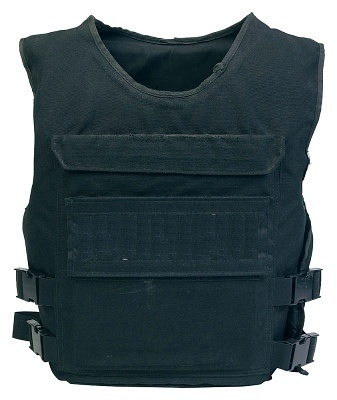
Body Armor in History
Body armor has been around since the beginning of the human race as a means to protect people from injury in combat and other dangerous situations. The description of these protective measures is well documented through history.
The first body armors were made of animal skins or leather. Leather was useful as a barrier for preventing slashing and piercing weapons of animals and early man, but proved to be less useful against crushing weapons. As weapon crafting skills, materials, and weapon design advanced the skins were replaced by wood and metal shields. Greek armors of bronze and brass with crafting similar to modern body armors are well documented in Homeric epics.
During the Norman Conquest of England a knight was considered fully armed if he used helmet, shield and a coat of mail (called hauberk by the Norman and byrnie by the English). By the 14th century, knights were commonly metal clad from head to foot in "plate mail", a heavy and cumbersome full body armor consisting of padded or leather under armor with hinged or riveted metal plates worn over it. Although bulky and movement restrictive, the knight had little to fear in combat when wearing the armor.
The discovery of gunpowder in the seventeenth century by Western Europe made the knight style body armor obsolete. Early firearm projectiles would easily penetrate the body armor causing mortal wounds, and the armor also limited the knight's movement, preventing him from evading the attack except on horseback. For some time, the only real protections against firearm projectiles were masonry or natural barriers.
At the end of 1800s and starting the twentieth century, silk body armor (the first bulletproof vest) was designed. It protected its wearer from low speed bullets (under 400 ft per second, generally black powder weapons at the time), but ammunition technology was proceeding too fast for it: the new generation of handgun projected bullets at 600 or more feet per second. In 1914 the Archduke Francis Ferdinand of Austria was using one of these bulletproof vestswhen he was killed by a shot to the head — precipitating World War I.
For more information on bullet proof vests, visit the Body Armor page at LibertyLib.


Grant
Americans believe they invented the first bullet proof body armour in Washington, sometime in the 1930’s. In fact the first known bullet proof armour was invented by an Australian from Irish decent, Ned Kelly. It’s about time he received credit where credit is due.