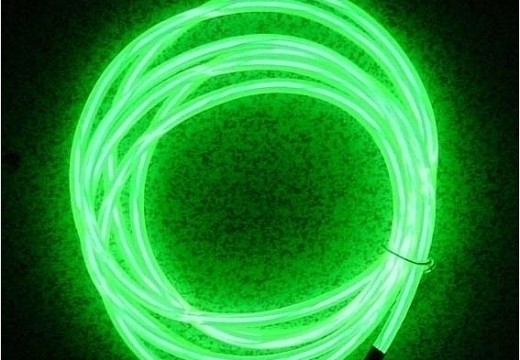
How Fiber Optic Lights Work
Fiber optic lines, which can be as thin as a piece of human hair, are made of strands of glass that are optically pure. They are used to transmit light signals, and have the ability to carry these signals over long distances.
How is Light Transmitted Through Fiber Optics?
The process by which light is transmitted through fiber optics can best be described through the use of an analogy.
If you want to shine a light through a tunnel, you can do so by pointing a flashlight down the tunnel in a straight line. However, if the tunnel has a curve, the straight line that the flashlight creates will not go through the entire tunnel. In order to get the light through the curve, a mirror must be added to reflect the light through the curve. The mirror will allow the straight line of light to be bent around the curve. The process of adding a mirror to bend the light can be repeated for however many curves are present in the tunnel.
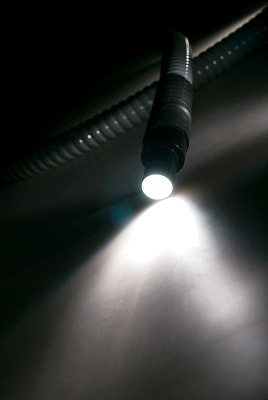
The process of bending a straight line of light is the same technique used to get light through fiber optics. The light is pointed down the core of the cable and makes its way through the cable by continuously reflecting off the interior of the fiber optics. Instead of the mirror used in the tunnel analogy, cladding (which is at least one layer of a material with a low refractive index) is used to reflect the light through the fiber optics cable. This process is known as total internal reflection.
There are two devices that can be used to generate the initial light that is transmitted through the fiber optic cable. The first device is a light-emitting diode (LED), which emits light when an electric current is applied in the device's forward direction. The second device that can be used at the beginning of the fiber optics process is an injection-laser diode (ILD), which is a solid state semiconductor that can emit stimulated radiation.
- How Traffic Lights Work
Many street lights are equipped with Traffic Signal Preemption systems like the 3M Opticom or the Tomar Strobecom. These systems enable emergency vehicles to change the traffic signals from Red to Green, and to change the traffic signals for others from Green to Red. This enables emergency vehicles to travel more quickly and more safely. [...]...
- DWDM (Dense Wavelength Division Multiplexing)
DWDM stands for Dense Wavelength Division Multiplexing. DWDM is a technology used to increase the capacity of fiber optics that results in faster transfers of data. What are fiber optics? Fiber optics are very thin and small fibers that are used to transmit data and light throughout a computer and network. How does DWDM affect [...]...
- How Traffic Cameras Work
There are several different types of traffic cameras. Some types of traffic cameras are only focused on traffic patterns and traffic density. Other types of traffic cameras are placed in locations where traffic infractions commonly occur to capture traffic incidents and record the details for punitive purposes. Cameras for Traffic Monitoring Cameras for traffic monitoring [...]...
- How Bullet Proof Vests Work
Also known as body armors, there are different types of bullet proof vests. The most common is the soft vest usually used by the police force and private security; it cannot stop ammunition of big caliber. Hard-plate reinforced vests are necessary when heavy ammunition is involved; they are used as part of the default equipment [...]...
- How Solar Panels Work
Solar panels are technically any kind of panel that uses solar thermal energy to produce electricity. There are a variety of panel types, from those used to heat water as with solar hot water panels, to those which are used to store solar energy, such as solar thermal energy panels. Furthermore, a solar panel can [...]...