

A PIR (Passive Infrared) sensor detects infrared light that is emitted from objects within its field of view. PIR sensors differ from other infrared sensors because they can only receive infrared waves. Because all objects emit infrared waves (electromagnetic waves that travel with heat), PIR sensors can detect objects that are in front of them. In fact, PIR sensors can detect many things that humans cannot. PIR sensors are used in many applications, such as night vision, motion detection, and laser range finding.
How PIR Sensors Work
PIR sensors are made of pyroelectric (or thermoelectric) materials and usually contain lenses or mirrors in order to focus the infrared light for maximum reception. As infrared light comes in contact with the pyroelectric material, which is usually a thin sheet, it creates an electrical current that can be measured to determine the intensity of the infrared light (depth perception) and the direction that it came from. Because of these properties, PIR sensors are able to determine how far away someone is and whether he/she is approaching the sensor.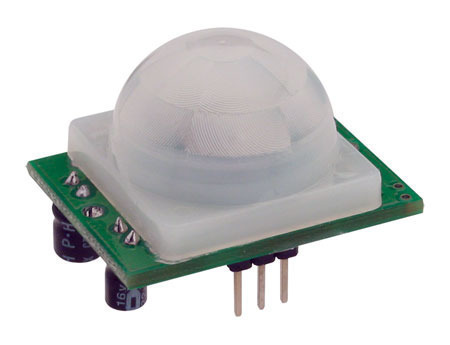
Applications
PIR sensors are used in many applications. They are used on television sets and television accessory devices, such as VCRs and DVD players, to detect infrared light coming from a television remote. PIR sensors are also used as motion detectors at most public doorways in grocery stores, hospitals, and libraries. PIR sensors can also be used for military purposes such as laser range-finding, night vision, and heat-seeking missiles.
Advantages
PIR sensors have several important advantages. They detect infrared light from several feet/yards away, depending on how the device is calibrated. PIR sensors are generally compact and can be fitted into virtually any electronic device. Also, they do not need an external power source because they generate electricity as they absorb infrared light.
Disadvantages
Although PIR sensors can be advantageous, they also have several disadvantages. PIR sensors can only receive infrared light and cannot emit it like other types of infrared sensors. They can be expensive to purchase, install, and calibrate as well.


swapnil
do pir sensors work during day (daylight)
JP
What is best way to connect PIR sensor to DVD player to play DVD when motion is sensed?
Quoc
May you give me the curve of PIR sensor ?
Holger
Hi specialists,
we have a technical question concerning reduction of PIR sensors power consumption by clockwise power supply:
Technical question to PIR sensor operation
Abtastzeitpunkte
PIR-Signal
U
t
Digitalisiertes PIR-Signal
For reduction of power consumption we like to power a PIR sensor in short intervals only. Assumption the sensor element Lithium-Tantalat-Cristal operates like a solar cell for IR radiation the measurement result as a voltage height is always present at the sensor element. That why we like to power the PIR for e.g. 2ms in an interval of 100ms only. The picture shows the effect of digitalization if a measurement curve becomes read all 100ms for a few ms only. This will be possible only if no RFI measurements like resistor in drain line and capacitor parallel to the source output of the JFET have been used. We like to have your information if something like this is possible and which sensor do you recommend for this. Do you have any information regarding a pulse wise supplied amplifier for this application? I would feel very pleased if you can help we with this required information.
Thank you.