

Photonic crystals are those that manipulate how photons are absorbed or reflected off of them. They occur in nature and are made of dielectric nanostructures that allow certain wavelengths to pass through them while blocking other wavelengths. The visible light portion of the electromagnetic spectrum’s wavelengths is responsible for colors, therefore photonic crystals can spontaneously emit exotic colors.
How Photonic Crystals Work
Photonic crystals are made of nanoscale structures that either allow or block individual wavelengths of light, depending on the frequency of their dielectric constants. Each wavelength of light has a unique physical size, which is what causes them to appear as different colors. In order for a wavelength to be allowed through a photonic crystal’s structure, it must be compatible with the the crystal’s dielectric fields. Wavelengths that can pass through these structures are called modes and groups of modes are called bands. Wavelengths that cannot pass through these structures are known as photonic band gaps. While wavelengths produce pure colors in photonic crystals, they tend to blend together at the photonic band gaps. This causes extreme colors to appear on the photonic crystal’s surface, thereby producing strange optical phenomena.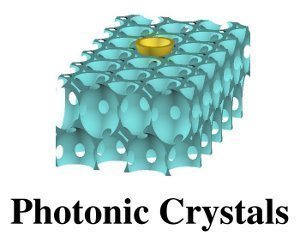
Applications
Photonic crystals have several applications, are artificially created, and are found in nature. They enhance computer chips by allowing important wavelengths to travel from one chip to another while blocking all other waves. Photonic crystals are also highly reflective and can serve as omni-directional mirrors. This property allows the creation of photonic crystal fibers, which are more efficient than regular optical fibers.
Advantages
Photonic crystals have several properties that make them advantageous. For example, photonic crystals can be constructed on the centimeter scale to interact with microwave frequencies in the same way that nanoscale photonic crystals interact with optical frequencies.
Disadvantages
While photonic crystals may one day play a major role in the technology industry, they are currently mostly theoretical. This is because photonic crystals are difficult to construct on a three dimensional scale, although several experiments have yielded promising results from their test subjects.

Follow Us!