

One of the technology terms that most people have become accustomed to hearing either at work or while surfing the Internet is the database. The database used to be an extremely technical term, however with the rise of computer systems and information technology throughout our culture, the database has become a household term.
A database is a structured collection of records or data that is stored in a computer system. In order for a database to be truly functional, it must not only store large amounts of records well, but be accessed easily. In addition, new information and changes should also be fairly easy to input. In order to have a highly efficient database system, a program that manages the queries and information stored on the system must be incorporated. This is usually referred to as DBMS or a Database Management System. Besides these features, all databases that are created should be built with high data integrity and the ability to recover data if hardware fails.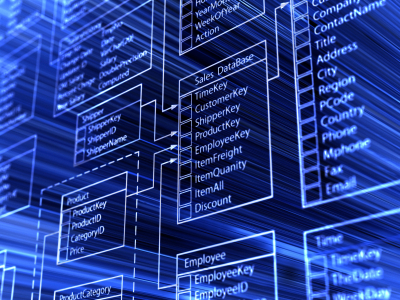
Types of Databases
There are several common types of databases. Each type of database has its own data model (how the data is structured). They include Flat Model, Hierarchical Model, Relational Model, and Network Model.
The Flat Model Database
In a flat model database, there is a two dimensional (flat structure) array of data. For instance, there is one column of information and within this column it is assumed that each data item is related to the other. For instance, a flat model database includes only zip codes. Within the database, there is only one column and each new row within that one column will be a new zip code.
The Hierarchical Model Database
The hierarchical model database resembles a tree like structure, such as how Microsoft Windows organizes folders and files. In a hierarchical model database, each upward link is nested in order to keep data organized in a particular order on a same level list. For instance, a hierarchical database of sales may list each day’s sales as a separate file. Within this nested file are all of the sales (same types of data) for the day.
The Network Model
In a network model, the defining feature is that a record is stored with a link to other records – in effect networked. These networks (or sometimes referred to as pointers) can be any type of information such as node numbers or even a disk address.
The Relational Model
The relational model is the most popular type of database and an extremely powerful tool, not only to store information, but to access it as well. Relational databases are organized as tables. The beauty of a table is that the information can be accessed or added without reorganizing the tables. A table can have many records and each record can have many fields.
Tables are sometimes called a relation. For instance, a company can have a database called customer orders. Within this database are several different tables or relations all relating to customer orders. Tables can include customer information (name, address, contact, info, customer number, etc.) and other tables (relations) such as orders that the customer previously bought (this can include item number, item description, payment amount, payment method, etc.). It should be noted that every record (group of fields) in a relational database has its own primary key. A primary key is a unique field that makes it easy to identify a record.
Relational databases use a program interface called SQL (Standard Query Language). SQL is currently used on practically all relational databases. Relational databases are extremely easy to customize to fit almost any kind of data storage. Relations can easily be created for items for sale, employees in a company, etc.
Accessing Information with a Database
While storing data is a great database feature, many database users consider quick and simple information retrieval the most important. It is extremely easy to pull up information regarding an employee in a relational database. Relational databases also add the power of running queries. Queries are requests to pull specific types of information and either show them in their natural state or create a report using the data. For instance, if someone had a database of employees that included tables such as salary and job description, he/she could easily run a query of which jobs pay over a certain amount. No matter what kind of information is stored on a database, queries can be created with SQL to help answer important questions.
Storing a Database
Databases can be very small (less than 1 MB) or extremely large and complicated (terabytes as in many government databases). However, all databases are usually stored and located on hard disks or other types of storage devices and are accessed via computer. Large databases may require separate servers and locations, however many small databases can fit easily as files located on the computer’s hard drive.
Securing a Database
Obviously, many databases store confidential and important information that not just anyone can easily access. Many databases require passwords and other security features in order to access the information. While some databases can be accessed via the Internet through a network, other databases are closed systems and can only be accessed on site.


Raju kumar yadav
very good brother………nice it’s very knowledgeful.
dounia
wooow great explanation thnx a lot
seif shaame seif
If the BDMS have unactive and you want to use a database what u do? please help me
kiran chalamala
good
Solly
A data model is a logical construct and retrieval of information. This happens when it has to eb stored, for use by GIS.
pussyeater
Nice stuff