

ATM (Asynchronous Transfer Mode) is a technological system developed for both local and wide area networks (LAN and WAN), and designed to handle data as well as video and voice traffic in real time, all at the same time. The system architecture makes use of switches that set up logical circuits at both ends of the data stream, which ensures unprecedented quality of service (QoS).
Unlike conventional telephone switches that sets up dedicated end-to-end circuits, unused bandwidth in Asynchronous Transfer Mode (ATM) can be used for other purposes if needed. For example, idle or unused bandwidth in a video conferencing meeting can be used to transfer data along the same line.
Large carrier networks (telcos) and large enterprises have made use of ATM technology but it has never been picked up for LAN use.
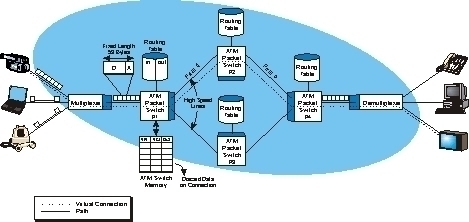
Key Elements of ATM Technology
One of the major innovations in ATM is the use of 53-byte fixed-length cells, unlike conventional TCP/IP which uses variable-sized packets. This allows ATM users to build very fast circuits, simply because it is easier to process known data packet sizes rather than to have circuits trying to pinpoint the start and end of data packets. The small ATM packet (composed of a five-byte header and a 48-byte data ‘container’) also guarantees that voice and video can be slotted into the data stream frequently enough for real-time transmission.
Constant Bit Rate, which guarantees sufficient bandwidth for voice and video transmissions in real time, Unspecified Bit Rate, providing ‘best effort’ service for non-critical data such as file transfers, Available Bit Rate (ABR) which fine-tunes bandwidth according to LAN traffic congestion levels and Realtime variable Bit Rate (rt-VBR) can support multimedia applications that require minimal delays
Another innovation in ATM technology is its ability to interconnect LAN and WAN protocols, allowing for a seamless transfer between WAN and LAN. One mode is called MPOA (Multi Protocol Over ATM) can be used to route TCP/IP protocols and IPX while maintaining ATM’s quality of service.
LANE (LAN Emulation) modes allows it to interconnect between rival Ethernet and Token Ring, summarizing their frames or data packets in LANE packets and then converting these into ATM 53-byte cells. MPOA or traditional servers can be used to interconnect differing LAN segments, with the ATM communications protocols handling data transfers.
ATM History and Developments
When ATM was originally conceived in the 1990s, many people saw it as the ‘next best thing’ in networking technologies since it could handle both LAN and WAN technologies, allowing users to ‘jump’ between LAN and WAN without difficulty, in other words, it would have become a single integrated system combining both.
Unfortunately, ATM never became a “magic” end-to-end solution integrating LAN and WAN technologies. ATM adapters for LAN-based desktops were expensive, and the standards for interconnecting networks using the ATM cell system were often confused and delayed. Telephone companies, ISPs and large corporations made use of ATM for their WAN architecture and critical backbones because of the QoS it could assure.
Follow Us!