

MagLev Trains are trains that rely on magnets or magnetic force to run. There are different kinds of MagLev Trains that have been developed and they differ on the technology used to attract the magnetic force or magnets to make the train run or levitate. Each project is developing its own version of Magnetic levitation but the main difference rests on the way the magnetic field is generated.
- The German model and the Japanese HSST (High Speed Surface Transport) use Electromagnetic Suspension (EMS). China in its Shanghai Maglev uses German technology. EMS uses the attractive magnetic force of a magnet beneath a rail to lift the train up.
- The Yamanashi Maglev (Japan) and the projected Florida MagLev use Electrodynamic Suspension (EDS). EDS uses a repulsive force generated by the interaction between the magnetic fields in the train and the rail to push the train away from the track.
- The project in Los Angeles (Indutrack) uses Permanent Magnet EDS.
The Shanghai Maglev Train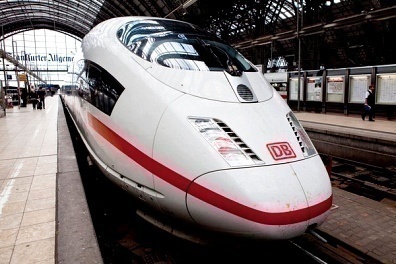
The Shanghai Maglev Train works under the German system (Transrapid), the frame of the train wraps around the guideway and the car levitates 3/8. by magnetic attraction to the underside of the track. The clearance is obtained via a closed-loop control system. The power for levitation is supplied on-board by batteries. The propulsion is created by the interaction of coils mounted on the guideway and passive rotors located on board.
The main advantage of the German Maglev system is the use of magnets don’t need to be superconducting and as such don’t need supercooling. The main disadvantage is the high weight of the vehicle.
The HSST (High Speed Surface Transport)
The HSST is one of the versions of Maglev developed by Japan. It uses an aluminum stationary rotor located on top of the steel track. The coils on board the vehicle induce a tractive force in the aluminum plate. The 280 VDC power needed for levitation is collected from conductors under the track. Closed loop sensors maintain the 3/8. vertical clearance and lateral stability.
The brakes work by linear induction regeneration helped by hydraulic shoes located on the guideway rails. The main advantage here, like in the German MagLev is the use of non-superconducting magnets. The main disadvantage is that the speed in this model is limited in comparison with the other Maglevs due to the close tolerances of the guideway.
The Yamanashi System
The Yamanashi system uses onboard superconducting magnets to perform the basic functions: levitation, guidance, propulsion, and braking.
In the first versions, the magnets where cooled by Liquid Helium. Liquid Helium sublimes very fast at room temperature; to keep the system going, the train employed an onboard helium re-liquefaction system. Later versions use rare earth ceramic materials as magnets; these ceramics have the property of crossing the supermagnetic threshold at higher temperatures and nitrogen liquid can be used as cooler (reducing costs). The internal braking system is helped by an aerodynamic brake done with large spoilers hinged on the roof of the vehicle.
The main advantage is that the onboard magnets allow a bigger levitation space, which translates in higher speeds. The main disadvantage is that the magnetic fields cannot be completely shield and any magnetic device inside the train could be affected including credit cards, pacemakers, magnetic storage devices, etc.

Train Sets
Lionel has been a name in model trains for a long time.They have several unique dimensions and types for everybody. While using corporation dating again to the early 1900’s, there’re nevertheless a well-liked pick for several. They’ve had their share of difficulties, but they are nonetheless right here and right here to stay.