

RADIUS (Remote Authentication Dial In User Service) is a system procedure that offers centralized entrance, approval, as well as accounting administration for individuals or computers to add and utilize a network service. Individuals often need “Authentication” when they try to fix to a network. People have to face far more problems while connecting their computers to a telecommunication network. For example, the telco wants to know the computer operator. When the identification is given, it may ask what services the user prefers. Plus, at that moment, the telco collects billing dates concerning the consumed time or capability.
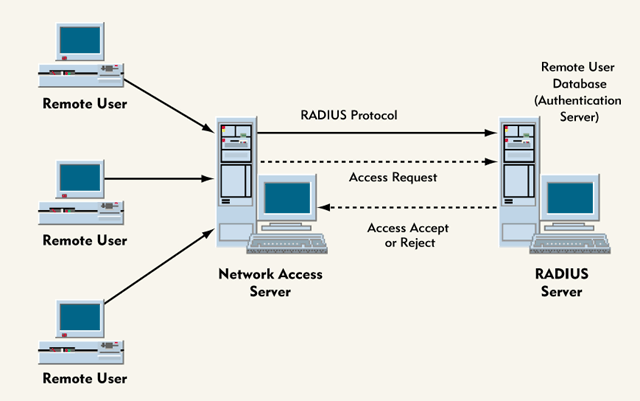
To solve all these problems and allow people to easily connect their computers to the telecommunication network, most the widespread open source and decorum systems use RADIUS. Telcos and other companies frequently put systems associated with RADIUS into services to identify their customers or employees with ease. RADIUS is good to use because it can easily determine the users’ authorized rights to execute and create a testimony of the entrance in the server’s “Accounting” feature.
RADIUS is, in fact, an open-regular and UDP-based protocol that the IETF originally developed. It mechanically combines the verification and authorization procedures that make it quite hard to run only one, but no more. Furthermore, RADIUS does not hold up the Novell Async Services Interface protocol, the NetBIOS Frame Protocol Control Protocol, X.25 Packet Assembler/ Dissembler, or even Apple Talk Remote Access Protocol.
However, the RADIUS associated servers can verify that the information is exact through confirmation schemes including PAP, CHAP, and EAP as well. Moreover, the RADIUS is frequently utilized to ease roaming services between ISPs and many companies use it because it provides a particular universal position of testimonials that most public networks can use. RADIUS’s primary use is for Internet Service Providers since it can be used on any network that requires a centralized verification and accounting services for its workstations.
Hence, RADIUS enables centralized running of certification data like usernames and passwords. The RADIUS server can accumulate these certified data locally, but it may also store authentication data in an outdoor SQL database or even an external Unix file. In fact, the RADIUS is an exceptional option to do accounting without any hassle. It can also improve safety by enabling password executive centralization. Overall, if people take over the RADIUS server, they would have everything.
Overall, RADIUS is good for Internet service providers and companies to identify their customers or workers with ease. It can help users connect their computers to telecommunication without hassle.

jee
how to connect to the Radius Server using the java language.
Or how to send/retrieve data from the Radius Server using the Java langa