ARP (Address Resolution Protocol)

ARP is the Address Resolution Protocol.

The ARP protocol maps addresses between the Data Link Layer and the Network Layer of the OSI Model.

The Data Link layer of TCP/IP networks utilizes MAC addresses; the Network Layer of TCP/IP networks utilizes IP addresses.

ARP and RARP

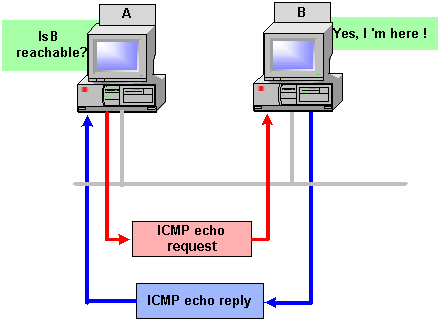
The ARP protocol is used to map IP addresses to MAC addresses.

RARP, the Reverse ARP Protocol, is used to map MAC addresses to IP addresses.
ARP ARP (Address Resolution Protocol)

The ARP Cache

To reduce the number of ARP requests, every system which implements the ARP protocol keeps a cache of recent mappings.

Additional Reading on ARP

To learn more about the ARP cache, read What is the ARP cache?

To learn how to clear the ARP cache, read How do I clear the ARP cache?

The ARP protocol is defined in RFC 826: An Ethernet Address Resolution Protocol.

The RARP protocol is defined in RFC 903: A Reverse Address Resolution Protocol.
VN:F [1.9.17_1161]
Rating: 9.0/10 (1 vote cast)
ARP (Address Resolution Protocol), 9.0 out of 10 based on 1 rating
Follow Will.Spencer on

Leave a Reply

Related Posts

  • ARP Cache

    The ARP cache is a table that stores mappings between Data Link Layer addresses and Network Layer addresses. The Data Link Layer addresses are usually MAC addresses and the Network Layer addresses are most frequently IP addresses. The Operating System stores the ARP cache in RAM. Displaying the ARP Cache Under most Unix and Microsoft [...]...


  • Understanding Host Name Resolution

    Understanding the Purpose of Host Names In TCP/IP based networks, the packets that are transmitted over the network contain the following IP addresses: The IP address of the computer sending the packet The IP address of the destination computer intended to receive the packet. The IP address information is used to forward the packet to [...]...


  • Understanding NetBIOS Name Resolution

    NetBIOS, broadcasts names to listening nodes on the network. NetBIOS utilizes a User Datagram Protocol (UDP) query to broadcast names. NetBIOS names identified computers on the network before the introduction of Windows 2000. The NetBIOS name is resolved to an IP address through Windows Internet Name Service (WINS), broadcasting, or the LMHOSTS file. If the [...]...


  • MAC Address

    A MAC address is an address that exists on Layer 2 of the OSI Model. Layer 2 of the OSI model is the Data Link Layer. The Data Link Layer consists of two sublayers, the Media Access Control (MAC) layer and the Logical Link Control (LLC) layer. The MAC sublayer controls how a network node [...]...


  • IP (Internet Protocol)

    IP (Internet Protocol) is the main network layer protocol utilized on the Internet. IP is responsible for addressing and fragmentation. IP works with another network layer protocol, ICMP. Transport layer protocols which utilize IP include TCP and UDP. IP Addresses IP addresses are four octets (32 bits) long and are usually seperated by periods. Some [...]...