

A Capacitor Bank is a group of several capacitors of the same rating that are connected in series or parallel with each other to store electrical energy . The resulting bank is then used to counteract or correct a power factor lag or phase shift in an alternating current (AC) power supply. They can also be used in a direct current (DC) power supply to increase the ripple current capacity of the power supply or to increase the overall amount of stored energy.
What Does a Capacitor Bank Work?
Capacitor banks work on the same theory that a single capacitor does; they are designed to store electrical energy, just at a greater capacity than a single device. An individual capacitor consists of two conductors which are separated by a dielectric or insulating material. When current is sent through the conductors, an electric field that is static in nature then develops in the dielectric which acts as stored energy. The dielectric is designed to permit a predetermined amount of leakage which will gradually dissipate the energy stored in the device which is one of the larger differences between capacitors and batteries.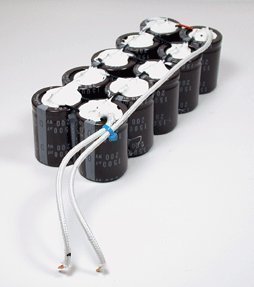
How is Capacitance Measured?
Capacitors are rated by the storing characteristic referred to as capacitance which is measured by the scientific unit, farad. Each capacitor will have a fixed value that they are rated at storing which can be used in combination with other capacitors in a capacitor bank when there is a significant demand to absorb or correct AC power faults or to output DC power.
What are the Applications of a Capacitor Bank?
The most common use of a capacitor bank for AC power supply error correction is in industrial environments which use a large number of transformers and electric motors. Since this equipment uses an inductive load, they are susceptible to phase shifts and power factor lags in the power supply which can result in a loss of system efficiency if left uncorrected. By incorporating a capacitor bank in the system, the power lag can be corrected at the cheapest cost for the company when compared to making significant changes to the company power grid or system that is supplying the equipment. Other uses for capacitor banks include Marx generators, pulsed lasers, radars, fusion research, nuclear weapons detonators, and electromagnetic railguns and coilguns.
Victor Mezquita
HOW TO CONFIGURE A SUPERCAPACITOR TO A LITHIUM BATTERY?
HOW TO CONNECT IN PARALLEL A SUPERCAPACITOR TO A LITHIUM BATTERY?