

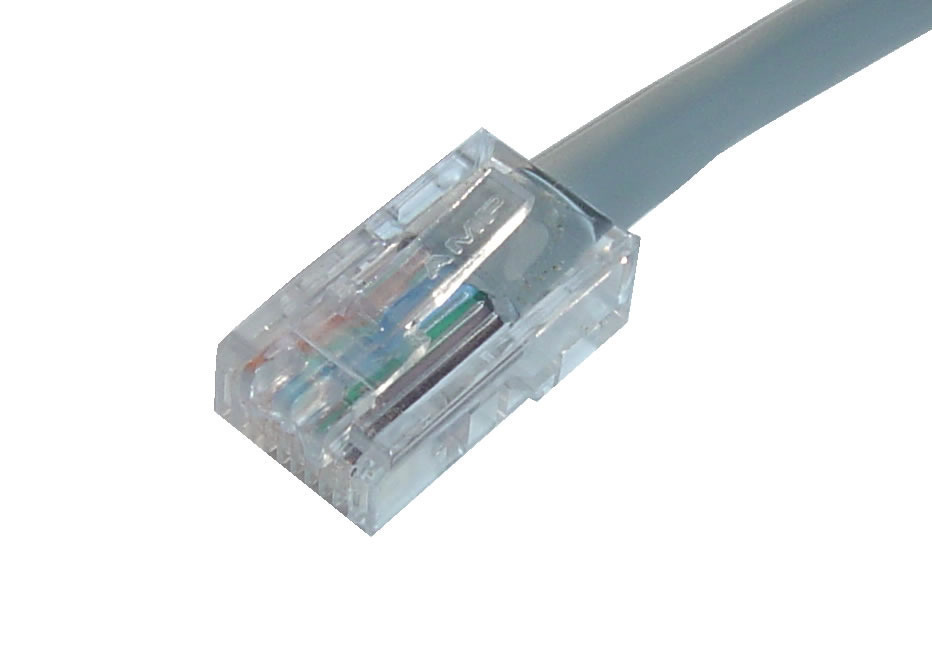
Cat 5, short for Category 5, is the current accepted industry standard for network and telephone wiring. Cat 5 is an unshielded twisted pair type cable exclusively designed for high signal integrity. The cable consists of four pairs of 24-guage twisted copper pairs terminating in an RJ-45 jack. If a wire is certified as Category 5 and not just twisted pair wire, then it will have "Cat 5" printed on the shielding.
The actual Cat 5 standard describes specific electrical properties of the wire, but Cat 5 is most widely known as being rated for its Ethernet capability of 100 Mbit/s. Category 5 cable comes with three twists per inch of each twisted pair of 24 gauge copper wires within the cable. The twisting of the cable helps to decrease electrical interference and crosstalk. Each wire in a Cat 5 cable is insulated with a plastic (FEP) which has low dispersion. The importance of this insulation is that the dielectric constant of the plastic does not depend mainly on frequency.
Twisted pair cable like CAT5 comes in two main varieties, solid and stranded. Solid CAT5 cable supports longer length runs and works best in fixed wiring configurations like office buildings. Stranded CAT5 cable, on the other hand, is more pliable and better suited for shorter-distance, movable cabling such as on-the-fly patch cabling.
Cat-5 cable replaces Cat-3 cable, which could only carry data at speeds up to 10 megabits per second (mbps), while Cat-5 cable supports data speeds of 100 mbps or more. A standard Cat-5 cable can also reach 300 feet (100 meters), and aside from networks and telephones it can be used for many other reasons. Cat-5e is enhanced Cat-5 cable that supports 1000 mbps or gigabit Ethernet, or it can be used with 100 Base-T networks for long-distance runs of 1150 feet (350 meters). This type of Cat-5 cable meets a specific standard referred to as "EIA/TIA 568A-5," which should be stamped on the outer sheath.
Uses of Cat 5 Cables
Cat 5 cables are widely used in structured cabling for computer networks such as Fast Ethernet. These types of cables are also ideal for carrying many other signals, including basic voice services, ATM, and Token Ring (at up to 155 Mbit/s, over short distances).
Category 5 E cable is similar to Cat 5 cable, except that it is made to somewhat more stringent standards. This enhanced version of Cat 5 cable is designed for using with 1000BASE-T (gigabit) networks or for long distance 100BASE-TX links (350m, when compared with 100 m for Cat 5).
Wiring Methods for Cat 5 Cable
Most Cat 5 cables are terminated with RJ-45 connectors. Solid core cables are commonly used for connecting wall socket and patch panels. Stranded cables are used for connecting patch leads between patch panel sockets and network switches. Stranded cable is also used for the connections between computers wall ports.
sundar
how connect cat5e cable woth cctv cameras