Home     Blog

Inductor

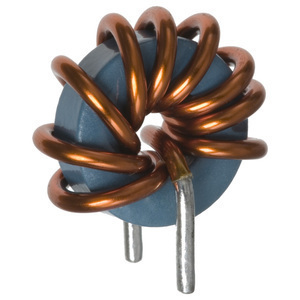
An inductor is a conducting coil, wrapped around a core, that creates inductance when an alternating current flows through it. Inductors are used to impede the flow of current in a circuit. The conductor is usually thin magnet wire, and the core is usually air or steel.
inductor Inductor

Working of an Inductor

When the alternating current flows through an inductor, it creates an electromagnetic field. The strength of this field depends on number of coils, the coil diameter and the permeability of the core material. Steel has a much higher permeability than air and produces a stronger field. As the current changes direction, the field also experiences a change and causes an induced current to flow in the opposite direction and impede the current flow.

Types of Inductors

There are three types of inductors: fixed, adjustable, and variable. Adjustable inductors have several point with different inductance, while variable inductors have moving parts that allow for greater control over the inductance. Inductors can also be defined by their core material. Generally, air-core inductors are used for higher frequencies, which would saturate a solid core.

Applications of an Inductor

Inductors are used as surge protectors because they block strong current changes. They are used as telephone line filters, to remove high frequency broadband signals and are placed on the ends of the cables to reduce signal noise. Inductors and capacitors are used together in audio circuits to filter or amplify specific frequencies. Chokes are small inductors that block alternating current and are used to reduce electrical and radio interference. A basic transformer is just two inductors wound around a large steel core. Their magnetic fields are coupled, because the core forces them to flow through both coils. When an alternating current flows in one coil, it induces an alternating current in the other coil.
VN:F [1.9.17_1161]
Rating: 10.0/10 (1 vote cast)
Inductor, 10.0 out of 10 based on 1 rating
Follow Will.Spencer on

Comments (4)


  1. Muhammad Khurram Ahmed says:

    Thanks! It proved to be very useful to me. I always had difficulty understanding purpose of inductor and difference between inductor and solenoid but this article helped me a lot.

    VA:F [1.9.17_1161]
    Rating: 0.0/5 (0 votes cast)
    • Beauty says:

      Did you just say it helped you? Are you sure you even understand it at all at all….. Lol

      VA:F [1.9.17_1161]
      Rating: 0.0/5 (0 votes cast)
  2. Beauty says:

    Please sorry for that comment, it was only a joke!

    VA:F [1.9.17_1161]
    Rating: 0.0/5 (0 votes cast)
  3. amit sharma says:

    its thanks to best knowledge by this site

    VA:F [1.9.17_1161]
    Rating: 0.0/5 (0 votes cast)

Leave a Reply

Related Posts

  • Solenoid

    A solenoid moves an iron core through the center of a wire coil when current flows through the coil. It is different to a relay which uses an electromagnet with a fixed iron core. Typical voltages used in solenoids are 12 and 24 volts. Some solenoids are controlled by pneumatic and hydraulic pressure instead of [...]...


  • Electromagnets

    Electromagnets are magnets whose magnetic properties come from or are generated through electricity. A magnet is a material (this is usually metal), which has at least one pair of negative and positive poles. These opposite poles' attraction produces a magnetic field. This gives the magnet the ability to 'attract' metals such as iron or steel. [...]...


  • Transformer

    A transformer transfers electrical energy between two circuits. It usually consists of two wire coils wrapped around a core. These coils are called primary and secondary windings. Energy is transferred by mutual induction caused by a changing electromagnetic field. If the coils have different number of turns around the core, the voltage induced in the [...]...


  • How Wireless Power Induction Works

    Wireless power induction is already being used today in the form of electric toothbrushes. An electric toothbrush contains coils or loops in the toothbrush handle as well as in the base recharging unit. Because of their constant exposure to water, electric toothbrushes have to use inductive coupling as a means of recharging their batteries. Inductive [...]...


  • Metal Detector

    A metal detector uses an electromagnetic field to detect the presence of a concealed metal object. The range depends on the strength of the field, and is usually less than one meter from the search head. The three detection methods are beat frequency oscillation, very low frequency, and pulse induction. Metal detectors were first introduced [...]...