

A piezoelectric transducer is a device that converts electricity into mechanical forces or vibrations. Although piezoelectric transducers have other uses, ultrasonic devices require them. Piezoelectric transducers usually converts electricity into vibrations and vibrations into electricity, although this is not always the case. They rely on two phenomena known as “electrostriction” and “the piezoelectric effect.”
How Piezoelectric Transducers Work
Piezoelectric transducers are made of both positive and negative elements that align themselves when in the presence of an electric field. This property causes them to actually change dimensions. When an alternating electric field is applied to the transducer, the material vibrates back and forth and produces an ultrasonic frequency. While most piezoelectric materials move back and forth between states, some are locked into their position and simply produce an electric current when mechanical forces physically move them. These types of piezoelectric materials are the foundation of ultrasonic sensors. Piezoelectric transducers were once made of piezoelectric crystals, but are now made of ceramic. They produce a wavelength that is twice the size of the element’s thickness. Because of this, elements are cut to be ½ the size of the desired wavelength. This also means that thinner elements produce higher frequencies.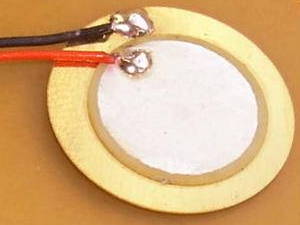
Applications
Piezoelectric transducers are most commonly used to produce ultrasonic frequencies and are sometimes referred to as ultrasonic transducers. They are also used as pressure meters and can be used at traffic lights to detect traffic, in fluid systems to eject and pump fluids, and in speakers to produce sound waves. Piezoelectric transducers can also be used in printing, vibration control, and noise suppression for both industrial and military vehicles such as helicopters, launch vehicles, submarines, and space platforms.
Advantages
Piezoelectric transducers are advantageous because of their ability to convert electrical and mechanical energy. They are now made of ceramic because ceramic is malleable, low voltage, and has efficient piezoelectric properties. Ceramic piezoelectric transducers can also withstand temperatures up to 300oC, magnetic fields, and other natural conditions.
Onewilly
I have designed a warning circuit that uses a conventional self contained Piezoelectric audio devcie. I have noted the back emf generated and placed a 1N914A reverse biased across the device power input. However, it had no noticable affect? It is operating from a 9 volt battery and the negative voltage with resepct to ground is about 3-4 volts peak. This negative voltage is being felt on the down stream side of a 5 volt regulator. Is there any way to supress this back EMF? If so, will it effect the sound pressure? THANKS!
jord
how could you amplify the voltage and current output of a single piezo
kapeso
Can you use a piezo sensor to measure the force of a punch?
Will.Spencer
In theory this could work. I have a friend who is using piezoelectric sensors to measure the sticks hitting an object. Have you looked into the Force-Sensing Resistors from InterLink Electronics as an alternative?