
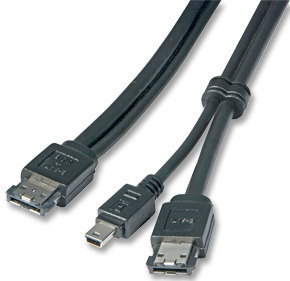
eSATAp is a high speed connectivity option for external storage devices like portable hard disks (HDD), Solid State Drives (SSD), and Networked Attached Storage (NAS). It is also referred to as eSATA/USB combo port and Power Over eSATA. This connection is 3 times as fast as USB 2.0, and its speed is comparable to USB 3.0 and Firewire 800. It is compatible with USB technology and is the preferred connectivity choice in the latest notebooks and PCs.
History
Serial ATA is a computer bus interf
[ read more ]
USB is an external hardware interface and communication standard used for connecting varied peripherals to a computer. These peripherals include mice, keyboards, scanners, digital cameras, mobile phones, printers, digital audio players, external hard drives, memory sticks, gaming peripherals and so on. It supports plug and play installation and hot plugging. USB has almost entirely replaced the usage of serial and parallel ports.
What does USB Stand For?
USB stands for "Universal Serial Bus".
[ read more ]
A PCI simple communications controller is a software component found on a computer that controls the PCI connected devices plugged into that computer. PCI (Practical Communication Interface) is a hardware component built into the computer that allows a wide variety of devices to physically connect to the computer via individual card slots. While the PCI allows the devices to be connected to the computer, the simple communications controller is responsible for managing the actions each device tak
[ read more ]
A common problem that arises for computer users is dealing with the USB Device not recognized error. This error is thrown after an electronic device is connected to the computer or USB hub but is not automatically detected. When the error occurs, the Windows Device Manager may also list the component as an “unknown device” depending on the nature of the error. Although more commonly encountered on Windows computers, Mac OS X users can also experience the equivalent error when connecting new
[ read more ]
A USB hub is a piece of hardware that allows for a single USB port to be expanded into several. This allows more ports to be used for different connected devices. For example, on a computer there might be four USB slots, but within the actual computer, there might only be a single upstream port. This means that the four downstream ports are connected to one port that leads within the computer. The USB hub allows for the four separate ports to connect together while keeping their autonomy and run
[ read more ]