Home     Blog

Relay

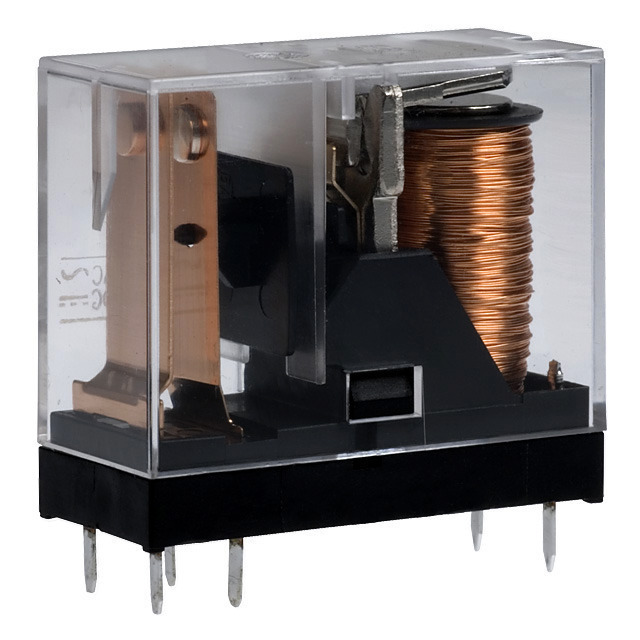
A relay is a remote switch controlled by current, magnetism, or temperature. The relay was invented in 1835 by Joseph Henry (1979-1878), an American scientist. Relays are a common component in many devices, and there are many different types of relays.
Relay Relay

Relay Types

The two main types of relay are electromechanical and solid-state. Electromechanical relays have a moving plate with contacts on it, while solid-state relays work similar to transistors and have no moving parts.

Power relays use an electromagnet to move a set of contacts. The contacts are pulled towards the electromagnet while current is flowing it. The contacts are connected to a spring that pulls them back when the current stops flowing.

Latching relays acts like a two-pole switch in that the contacts stay in position when when the current stops flowing. This is achieved by using a solenoid to move a ratchet and cam, or by using an electromagnet on either side.

Reed relays have only a set of ferro-metallic contacts inside a glass tube. The contacts close when an external magnetic field is applied, and open again when it is removed. Reed relays are commonly used as door sensors for alarm systems.

Overload relays are similar to reed relays but use a bimetallic strip to move the contacts. High temperature causes the strip to bend, bringing the contacts together.

Relay Applications

Relays are used to control the flow of large currents using a small current. In the past, they were widely used in telephone exchanges to switch calls, but have been largely replaced by digital equipment. They are used to switch motors on and off, and to protect them from overheating. Thermostats use an overload relay to shut off the current when the temperature rises above the required setting.

Solenoids and Relays

A solenoid is a special type of relay that has a moving core, while the electromagnet core in a relay is fixed. Solenoids are mostly used as mechanical actuators but can also be used for switching large currents, while relays are only used to switch currents.
VN:F [1.9.17_1161]
Rating: 0.0/10 (0 votes cast)
Follow Will.Spencer on

Comments (3)


  1. Akram Saif says:

    hello
    good day
    plz well help me
    i can not found solid state relay 2cr 12v (italy made)
    plz tell me from where can i found it or which kind of relays can i chinge it to
    best regards

    VA:F [1.9.17_1161]
    Rating: 0.0/5 (0 votes cast)
  2. Daniel Memenode says:

    Originally posted by Akram Saif: “hello
    good day
    plz well help me
    i can not found solid state relay 2cr 12v (italy made)
    plz tell me from where can i found it or which kind of relays can i chinge it to
    best regards”

    You could check who sells it. :P

    VN:F [1.9.17_1161]
    Rating: 0.0/5 (0 votes cast)
  3. abhishek mishra says:

    what is the full fom ref

    VA:F [1.9.17_1161]
    Rating: 0.0/5 (0 votes cast)

Leave a Reply

Related Posts

  • Solenoid

    A solenoid moves an iron core through the center of a wire coil when current flows through the coil. It is different to a relay which uses an electromagnet with a fixed iron core. Typical voltages used in solenoids are 12 and 24 volts. Some solenoids are controlled by pneumatic and hydraulic pressure instead of [...]...


  • Circuit Breakers

    A circuit breaker is a device that automatically breaks an electrical circuit whenever the circuit becomes overloaded or an unintentional short circuit occurs. Circuit breakers have a set electric current load capacity which when breached results to automatic circuit shutdown. Overloading occurs whenever the wires comprising an electrical circuit are forced to carry and conduct [...]...


  • Electromagnets

    Electromagnets are magnets whose magnetic properties come from or are generated through electricity. A magnet is a material (this is usually metal), which has at least one pair of negative and positive poles. These opposite poles' attraction produces a magnetic field. This gives the magnet the ability to 'attract' metals such as iron or steel. [...]...


  • Spark Gap

    A spark gap consists of two electrodes separated by a small gap that is filled by a gas, usually air. The potential difference across the gap increases until it reaches the level where the gas ionizes and current flows across it for a brief time. The two types of spark gap are the static and [...]...