

A rheostat is an electrical component that has an adjustable resistance. It is a type of potentiometer that has two terminals instead of three. The two main types of rheostat are the rotary and slider. The symbol for a rheostat is a resistor symbol with an arrow diagonally across it. Rheostats are used in many different applications, from light dimmers to the motor controllers in large industrial machines.
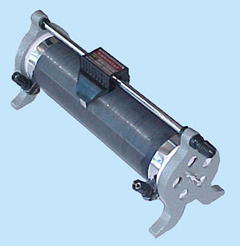
Rheostat Construction
Most rheostats are the wire-wound type that have a long length of conductive wire coiled into a tight spiral. The linear type has a straight coil, while the rotary type has the coil curved into a torus to save space. The coil and contacts are sealed inside the case to protect them from dirt, which can cause an open circuit, and from moisture, which can cause a short circuit. Rheostats can be made from other materials such as carbon disks, metal ribbons, and even certain fluids. As long as a material has a significant resistance change over a short length, it can probably be used to make a rheostat.
How Rheostats Work
The basic principle that rheostats use is Ohm’s law, which states that current is inversely proportional to resistance for a given voltage. This means the current decreases as the resistance increases or it increases as the resistance decreases. Current enters the rheostat through one of its terminals, flows through the wire coil and contact, and exits through the other terminal. Rheostats do not have polarity and operate the same when the terminals are reversed. Three-terminal potentiometers can be used as rheostats by connecting the unused third terminal to the contact terminal.
Applications
Some light dimmers use rheostats to limit the current passing through the light bulbs in order to change their brightness. The greater the rheostat’s resistance, the lower the light bulbs’ brightness. Some lights cannot use dimmers, such as fluorescents and gas discharge lamps. These lights have large resistance loads called ballasts, that maintain a constant current through them. Rheostats have no effect on their brightness and can even damage them.
Motor controllers also use rheostats to control a motor’s speed by limiting the flow of current through them. They are used in many small appliances such as blenders, mixers, fans, and power tools. Rheostats are also used as test instruments to provide an accurate resistance value. While rheostats can be used to control electric ovens and cooktops, thermostats are preferred because they have additional parts that automatically adjust the current flow to maintain a constant temperature.
The rheostat is still a common and fundamental electronic component used to control the flow of current in a circuit. However, it has largely been replaced by the triac, a solid-state device also known as a silicon controlled rectifier (SCR). A triac does not waste as much power as a rheostat and is more reliable due to the absence of mechanical parts. Rheostats commonly fail because their contacts become dirty or the coil wire corrodes and breaks.
Amanda
what happens when we change the rheostat ‘s cursor ‘s direction?
Budoy
What type of rheostat will i going to used if im going to make a Regulated power supply of 220Vac and an output of 24Vdc??….
every answer will be appreciated…i hope its ok to asked in this section…thanks much much!…
GP VITTAL
For continues current loading we require Rheostats of different rating
Please quote a bugdtary offer for different varatings
10 VA TO 500VA , 1 aMPS TO 5 AMPS & 10 AMPS
Vittal
Kristen Stewart
a rheostat is a resistor used to adjust current in a circuit.can any body please tell me what is the use of ammeter
Kristen Stewart
a rheostat is a resistor used to adjust current in a circuit.
can any body please tell me what is the use of ammeter
Kate
An ammeter measures the electric current in a circuit.
ishtiaque ahmed
kindly tell me what rating should i take of the following
1. Shunts &
2. Rheostats in cathodic protection
jambolia
how do we construct rheostat?
the wires are insulated from each other ( by some means i dont know) otherwise it ll act as a conducting strip. if they r covered by some insulating material then how jockey connects with the wire? i hope my question is clear.
vivek soni
i am use a rheostat which use a rectifier panel. incoming of panel is 440 vac and output is 190 v dc to use in a magnetic break .but i am face a problem the rheostat is heat when break open ad closed.can i change rheostat.or winding the rheostat.
Swagat 2011
Are there other applications of RHEOSTAT other than controlling the amount of current in a circuit????
shailesh dhaduk
hey, if inductor have its own very small resistance, then why resistance do not have some inductance value ??????(raised this question because both are wounded coils simply)
who can answer ??
Will.Spencer
Why would a resistor have an inductance value? An inductor has resistance due to electron friction, radiation losses, eddy currents, magnetic hysteresis. On the other hand, there is nothing about a resistor that would cause inductance to spontaneously occur.
vishakha
what material is the rheostat wire made of..?
memenode
They’re typically made from an alloy of 80% nickel and 20% chromium, a brand of material called “Nichrome”.
Karen
Thx
Alex
If I have a 24V 250W halogen bulb that I want to put on a dimmer, can I use a rheostat between the bulb and 120V AC from the wall? If YES, then how many Ohms rating are required?
dawn sulliven
I have a question.
I just moved into a different home and the light switch plate gets hot when the light with the dimmer switch is turned on. Is it normal for a rheostat to cause the plate to be hot? There are two lights controlled by the two switches in the same box–one a regular switch and one a rheostat. The side with just a switch is not hot at all. Thanks you for any help.
Will.Spencer
Dawn:
It is normal for dimmer switches to become warm, but trouble can be caused if a dimmer switch becomes too hot. You might need to replace the dimmer switch with a higher capacity (wattage) unit. How many light bulbs are in each of those lights and what is the wattage of each bulb? Also, if the electrical box where the dimmer switch is installed is plastic, you might look at replacing it with one of the older metal boxes which are better at radiating heat.
Zuhaib
Actually the rheostate works in two ways
1. As a variable resistor.
2. As a Potential divider.
1. As a variable resistor:-
It has two fixed terminals i.e terminal A and terminal B. And one sliding contact which may slide over the rod consisting terminal A and B. The sliding contact may slide with the Jockey. Therefore we can change the resistance with the help of rheostat.
2 As a Potential Divider:-
It is impossible to discuss here because one can understand it with the help of diagram. So we can’t draw a diagram in this website.
dragonrider
hi !!
will this rheostat can be applicable on AC also ? reply me soon !!
thanks in advance to the answer !! 🙂 🙂
sohan
yes we can also used the rehosta in ac supply both as parallel and as series combination of the cricuit.
we can esily current and voltage are control in tha ac cricuit witha thae help of rehostat