

A Zener diode transfers current forward and backward, while traditional diodes are only capable of transferring current forward. Many different electronic systems use Zener diodes to control their circuit’s voltage levels. While there are several ways of doing this, Zener diodes provide efficient voltage regulation without damaging the diode itself.
How Zener Diodes Work
For the most part, a Zener diode acts like a regular diode as current moves in a forward direction in its circuit. However, when a large enough voltage is applied to the diode in the reverse direction, it travels against the current from the output to the input. Generally, this produces a current build-up that eventually damages the diode. However, Zener diodes can limit the amount of current that passes through them so that the voltage going backward limits the voltage going forward.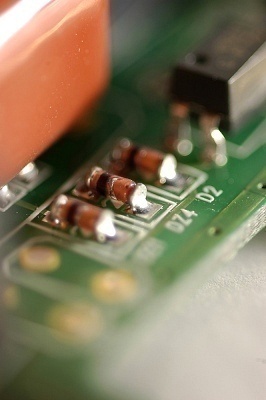
Applications
Zener diodes are used in a number of electronic devices but are exclusively used to control voltage levels within an electrical circuit. They are especially used in power supplies where alternating current is converted into direct current. These types of power supplies typically transfer very large voltages and must limit the voltage before it is transferred to an electronic device. These devices are often referred to as rectifiers and either a Zener diode or several transistors can control them. However, in the case of one-chip regulators, transistors are too large and a single Zener diode can perform the same function.
Advantages
Zener diodes are very small and can be integrated into virtually any electronic device, especially small circuits that cannot accommodate other forms of voltage regulation technology. Zener diodes are also relatively inexpensive and are compatible with most other systems, making them the preferred voltage regulation device.
Disadvantages
Zener diodes cancel out voltages by applying even larger voltages in the reverse direction, wasting electricity in the process. Additionally, Zener diodes have a relatively poor regulation ratio and are generally not as good as transistors.

Follow Us!