RAID stands for Redundant Array of Independent Disks and it basically involves combining two or more drives together to improve the performance and the fault tolerance. Combining two or more drives together also offers improved reliability and larger data volume sizes. RAID distributes the data across several disks but the operating system considers this array a single disk.
RAID Levels
RAID 0
RAID 0 uses data stripping as the data is broken into fragments while writing it to the drive. The
[ read more ]
A sector is a small area on the surface of a hard drive or floppy disk.
Hard drives usually have several platters. The platters are the discs that are covered with magnetic material, which is used to hold data. Floppy disk drives contain only one platter.
Platters are divided into a set of concentric rings called tracks. A 1.44MB floppy disk has 160 tracks. Hard drives have thousands of tracks.
Each of these tracks is divided into smaller storage areas called sectors. A sector is the sm
[ read more ]
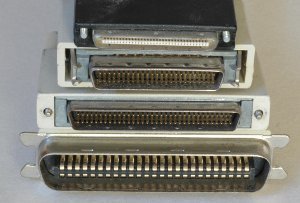
PATA is an abbreviation for Parallel Advanced Technology Attachment. It is a regular interface that is used within PCs to connect all kinds of storage devices like hard disks, CD or DVD drives and solid state disks to the motherboard. The PATA interface connector is made up of thirty four pins and is connected to a ribbon-like flat cable nearly two inches broad. It does not support hot swapping. PATA was earlier known as just Advanced Technology Attachment. But with the introduction of SATA (Ser
[ read more ]
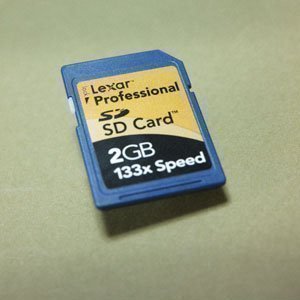
Secure Digital (SD) memory cards are very simple to format. There are 3 main options to format the SD cards to the format needed. To successfully format an SD card, the write protection lock on the side of the card must be in the "unlock" position. SD mini and micro SD cards must be used with an adapter or specialized USB card reader when a computer is formatting them.
The first option is to use a format utility. On most computer systems, there are generic formatting utilities available for n
[ read more ]
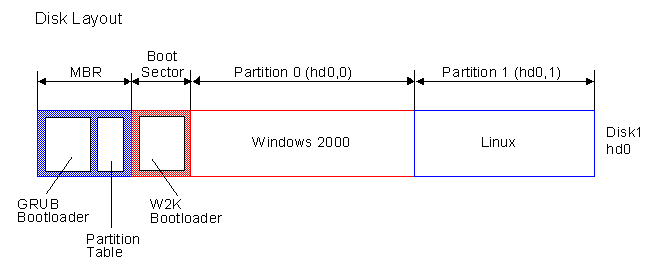
The MBR is the Master Boot Record.
The MBR is a small program which runs whenever a computer boots up.
The MBR is stored in the first sector of the boot disk.
The boot disk may be a hard drive, a floppy drive, or even a CD or DVD drive.
The Task of the MBR
The normal job of the MBR program is to search the partition table for the active partition, copy the boot sector from the active partition into memory, and transfer control over to that program.
If the MBR cannot accomplish this task
[ read more ]
RAID (Redundant Array of Independent Disks) is a data reliability and redundancy system that allows data to be stored on multiple computers at the same time. RAID technology is generally used in industrial, commercial, and government computer networks to store copies of system and user files on multiple hard drives that are connected through a logical unit and the network. RAID technology allows companies, agencies, and other institutions to ensure that important files are never lost or that sys
[ read more ]
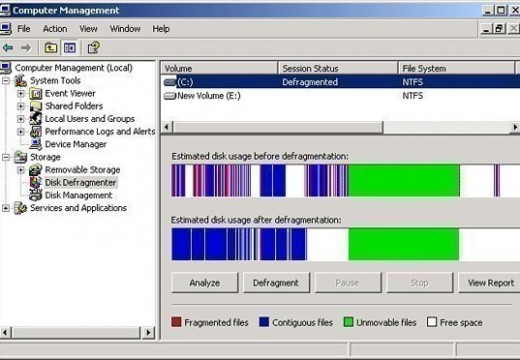
File and disk fragmentation usually causes problems in large networked companies where many people simultaneously save, retrieve and delete their work on a company's servers.
In an ideal scenario, people will be 'lining up' to use the company's servers, allowing data management (especially storage and retrieval) to proceed in an orderly, logical, and sequential manner. In reality, people are working simultaneously. This results in pieces of data being stored on servers in a seemingly random m
[ read more ]
Striping is the automated process of writing data across multiple drives simulteneously. Striping is used to increase the performance of disk reads.
When using striping, if you write a 5GB file across 5 drives, 1GB of data is written to each drive. Parallel reading of data from multiple disks can have a significant positive impact on performance, because the physical disk drive is most often the performance bottleneck.
Striping is used in RAID Level 0.
If one drive in a striped set fail
[ read more ]
iSCSI stands for Internet SCSI, or Internet Small Computer Systems Interface. iSCSI is the transmission of SCSI commands and data over IP networks, and represents a networking standard for IP-based network data storage. The development of the IETF standard was considered to be the key enabler for expanded usage of storage area networks (SANs) throughout the marketplace. iSCSI technology can be deployed on local or wide area networks through the use of the Internet across distributed resources.
[ read more ]
eSATA stands for External Serial Advanced Technology Attachment. It is meant to be an external interface for SATA technologies. SATA or Serial ATA (Advanced Technology Attachment) is the next generation of drive interfaces, its predecessor being the Parallel ATA (PATA).
PATA
Anyone who has opened up their computer must have noticed the flat, 40-wire parallel cables that are used to connect the hard disk, CDROM and other devices to their respective controllers; these are typical PATA connec
[ read more ]