Home     Blog

Symmetric and Asymmetric ciphers

In a symmetric cipher, both parties must use the same key for encryption and decryption. This means that the encryption key must be shared between the two parties before any messages can be decrypted. Symmetric systems are also known as shared secret systems or private key systems.

Symmetric ciphers are significantly faster than asymmetric ciphers, but the requirements for key exchange make them difficult to use.

In an asymmetric cipher, the encryption key and the decryption keys are separate. In an asymmetric system, each person has two keys. One key, the public key, is shared publicly. The second key, the private key, should never be shared with anyone.

When you send a message using asymmetric cryptography, you encrypt the message using the recipients public key. The recipient then decrypts the message using his private key. That is why the system is called asymmetric.
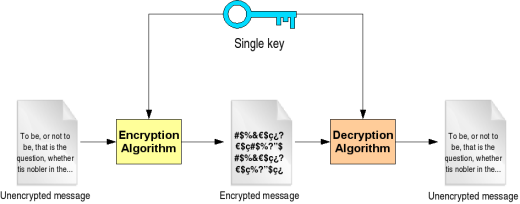
symmetric and asymmetric ciphers Symmetric and Asymmetric ciphers

Because asymmetric ciphers tend to be significantly more computationally intensive, they are usually used in combination with symmetric ciphers to implement effect public key cryptography. The asymmetric cipher is used to encrypt a session key and the encrypted session key is then used to encrypt the actual message. This gives the key-exchange benefits of asymmetric ciphers with the speed of symmetric ciphers.

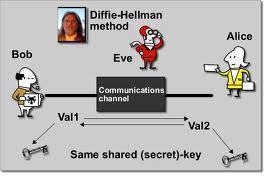
DES and AES / Rijndael are symmetric ciphers. RSA and Diffie-Hellman are asymmetric ciphers.

VN:F [1.9.17_1161]
Rating: 0.0/10 (0 votes cast)
Follow Will.Spencer on

Comments (2)


  1. sahar says:

    love the science

    VA:F [1.9.17_1161]
    Rating: 0.0/5 (0 votes cast)
  2. red says:

    wdawrtwwwwwwwwwwwwwww

    VA:F [1.9.17_1161]
    Rating: 0.0/5 (0 votes cast)

Leave a Reply

Related Posts

  • Block and Stream Ciphers

    Block and Stream Ciphers are two categories of ciphers used in classical cryptography. Block and Stream Ciphers differ in how large a piece of the message is processed in each encryption operation. Block Ciphers Block ciphers encrypt plaintext in chunks. Common block sizes are 64 and 128 bits. Stream Ciphers Stream ciphers encrypt plaintext one [...]...


  • Substitution and Transposition Ciphers

    Substitution and transposition ciphers are two categories of ciphers used in classical cryptography. Substitution and transposition differ in how chunks of the message are handled by the encryption process. Substitution ciphers Substitution ciphers encrypt plaintext by changing the plaintext one piece at a time. The Caesar Cipher was an early substitution cipher. In the Caesar [...]...


  • One-Time Pad

    A one-time pad is the only theoretically unbreakable cipher. A one-time pad is a private key, or symmetric, cipher where the key size is equal to the plaintext size. Because of this, the key is never reutilized. As the key is never reutilized, there is no basis for mathematical cryptanalysis. An example of a very [...]...


  • Cryptographic Algorithms

    Symmetric Cryptographic Algorithms DES (Data Encryption Standard) is perhaps the most widely used cryptographic algorithm. DES is based upon IBM’s Lucifer algorithm. The NBS (National Bureau of Standards) and the NSA (National Security Agency) adopted DES as a federal standard in 1977. DES is a symmetric cipher with an effective key length of 56 bits. [...]...


  • RC4 (Rivest Cipher 4)

    RC4 is a symmetric stream cipher with an arbitrary key size. RC4 was created by Ron Rivest of RSA Security in 1987. RC4 is used in many applications, including TLS (Transport Layer Security), WEP (Wired Equivalent Privacy), WPA (Wi-Fi Protected Access), TKIP (Temporal Key Integrity Protocol), Microsoft XBOX, Oracle SQL, Microsoft PPTP, Microsoft Office, and [...]...