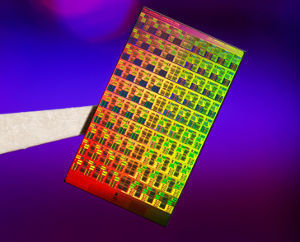
A Compact Flash card is an IC (Integrated Circuit) which is stored in a compact and rugged plastic enclosure. Compact Flash cards are designed to store data and to enable the transfer of data between devices equipped with Compact Flash slots.
Current Compact Flash capacities range up to 4GB.
Compact Flash Type I cards are 43mm long, 36mm wide, and 3.3mm thick.
Compact Flash Type II cards are 43mm long, 36mm wide, and 5mm thick.
The theoretical transfer speed of Compact Flash 2.0 is 16MB/se
[ read more ]
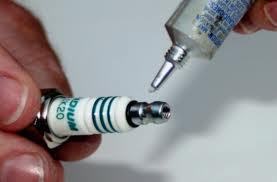
Dielectric grease is a translucent substance used to seal electrical conductors in order to prevent dirt, dust, sand, and other foreign materials from sticking to the conductor and preventing it from transferring a current between the two contact points. Dielectric grease also blocks moisture, thereby preventing corrosion.
How Dielectric Grease Works
Dielectric grease is a translucent substance. Therefore, some light passes through it and causes distortion. Dielectric grease is usually gray
[ read more ]
DVD Authoring is the process of creating or adding interactive content and graphics to an audiovisual DVD, which can then be played in a DVD player. DVD authoring is usually done on audiovisual DVDs as opposed to music discs and it is accomplished with the help of DVD authoring software. In the following paragraphs, we'll see the licensing requirements for DVD authoring softwares in general and the advantages of DVD authoring in the practical world other than entertainment.
As per the rule
[ read more ]
Bluetooth is a wireless communication protocol that allows multiple devices to communicate with each other and share files when they are in range. While Bluetooth is a rather new technology, it has quickly become a feature that the vast majority of wireless devices support and can be used with laptops, cell phones, PDAs, Bluetooth-enabled desktops, cameras, video game consoles, printers, fax machines, GPS receivers, and other fixed and mobile wireless devices. Bluetooth is an open wireless stand
[ read more ]
Whenever you make a dramatic change to your computer, such as installing a new operating system, reformatting the drive partition, or editing the system files, you need to backup your entire disk. Most of the time, system changes go through with no problems but if you do not back up your drive beforehand, you can lose everything that was on your computer. There are many methods to backing up your computer and each method has its own pros and cons. In this article, we will go over each of these m
[ read more ]
An SD (Secure Digital) card is a portable storage device that stores data even when it is not powered. SD cards are very small and fit in many portable devices such as cameras, video game consoles, and cell phones. They can also be used with both desktop and laptop computers if the user purchases an SD card adapter. While SDSC (SD Standard Capacity) cards store up to 4 GB, there are also SDHC (SD High Capacity) and SDXC (SD eXtended Capacity) versions that store up to 32 GB and 2 TB respecti
[ read more ]
An incremental backup is a backup of every file on a file system which has changed since the last backup. The alternatives to an incremental backup are differential backup and full backup.
An incremental backup is the fastest backup and requires the least storage space on the backup media. However, incremental backups also require the longest time and many tapes to restore.
Incremental backups should be used only in environments where backup time or backup storage media are extremely constrain
[ read more ]
The Universal Serial Bus (USB) interface connects peripherals in a variety of ways. These peripherals include the standard and non-standard computer mouse, keyboards, gaming controllers, scanners, printers, digital cameras, hard disks, CD/DVD-Rom drives, card media devices, music devices, speakers, and networking components. A variety of other devices that use USBs as well as devices that may use the USB pinout design to provide power, access data, or distribute the connections are available.
[ read more ]
RAID stands for Redundant Array of Independent Disks and it basically involves combining two or more drives together to improve the performance and the fault tolerance. Combining two or more drives together also offers improved reliability and larger data volume sizes. RAID distributes the data across several disks but the operating system considers this array a single disk.
RAID Levels
RAID 0
RAID 0 uses data stripping as the data is broken into fragments while writing it to the drive. The
[ read more ]
One of the most common hardware problems that people who own a laptop experience is a broken or malfunctioning laptop screen. Laptop screens are essential to laptop use. Laptop screens can be incredibly delicate. However, they are surprisingly very easy to fix even if the fixer is not a technical person.
Troubleshoot the Laptop Screen Problem
Before replacing a laptop screen, it is wise to troubleshoot the problem. While obvious damage to a screen usually requires full replacement, other typ
[ read more ]