

A computer network can be segmented physically and logically. A collision domain is one of the logical network segments in which the data packets can collide with each other. One of the most common protocols used when referring to a collision domain is the Ethernet protocol. Collision domains are often referred to as ‘Ethernet segments.’
The term ‘collision domain’ is also used when describing the circumstances in which a single network device sends packets throughout a network segment and forces every other device in that network segment to pay attention to those packets.
CSMA/CD and Collision Domains
A collision domain can also be a group of Ethernet/Fast Ethernet devices in a Local Area Network running on the Carrier Sense Multiple Access/Collision Detection (CSMA/CD) feature and is also connected through repeaters, thus competing for network access. Since only one device in the same collision domain can transmit data at a certain point, the other devices in the network simply listen in order to avoid data collisions.
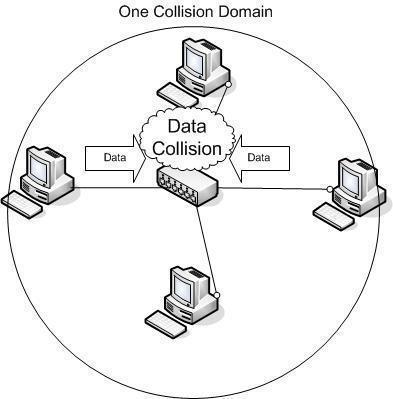
CSMA/CD is a set of rules telling each network device when to transmit and when to stop transmitting data. When someone in the network wants to transmit something, it “listens” to the network at first in order to see if anyone else is using the channel. If no one else is transmitting, the device will go forward with its own transmission.
Using CSMA/CD is an efficient way of avoiding network collisions, but it is not foolproof. It is obvious that if two devices follow the exact procedure at the exact same time, their transmissions will collide and they will both become unusable. A jam signal will be sent in order to let everyone else know that a collision took place and they should not send any data. The hosts that collided will each start a random timer and when that ends, each host will begin to listen on the network again.
Of course, the more collisions in a network, the less efficient the network is.
‘Collision domain’ sometimes refers to a system where a unique identifier is open for multiple interpretations over different layers. The analogy to an Ethernet collision domain is very clear, if not obvious.
A collision occurs when two or more network devices are trying to transmit packets at the same time.
How to Reduce the Collision Domain Size
Reducing the collision domain size can be the result of installing network devices (usually switches and/or network bridges) that use microsegmentation.
Unlike network hubs and regular repeaters that usually broadcast every single packet, LAN switches are able to filter and forward packets by their MAC address (Media Access Control). The switch basically reads the 48-bit MAC address from the network card and filters or stops frames inside the LAN or a certain network domain.
A switch or network bridge forwards frames with addresses that are not in its domain and will duplicate and broadcast frames to the devices inside its network.
A router can also filter, forward, or drop packets based on the MAC addresses, but it can also act based on the Internet Protocol (IP). Routers also reduce the collision domain by broadcasting only packets that have addresses on that certain network to the LAN. These network devices are able to route or redirect packets not only by the IP or MAC addresses, but also by the data type (email, graphics, plain text), function or port used (FTP, HTTP, SMTP, POP3), and other variables and functions (acting like a firewall) in order to improve the performance and reduce the number of collisions and control/limit users.
Follow Us!