Home     Blog

Fibre Channel

Fibre Channel

Fibre Channel is a set of standards for connecting storage devices in a fabric network. The Fibre Channel standard identifies a protocol and a collection of physical interfaces for managing computer peripheral components. This standard's key purpose is managing large numbers of storage devices. Fibre Channel uses serial interfaces working at symbol rates from 133MB/s up to 4.25Gb/s. Optical as well as electrical signals are supported. Fibre Channel supports data transmission rates of 100MBps. I

[ read more ]

HBA (Host Bus Adapter)

HBA (Host Bus Adapter)

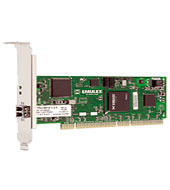
An HBA (Host Bus Adapter) is the interface card that connects a host to a SAN (Storage Area Network). It is an electronic circuit board and/or integrated circuit adapter that offers input/output (I/O) operations and physical connectivity among a server and a storage device. Presently, the phrase Host Bus Adapter (HBA) is frequently used for Fibre Channel interface cards. Fibre Channel HBAs are obtainable for all key open systems, computer architectures, and buses. Every HBA has a distinctive

[ read more ]

What is Storage Virtualization?

What is Storage Virtualization?

System Administration concepts such as storage virtualization simply separate the logical storage from physical storage on a storage medium. This provides greater flexibility for systems administrators in managing storage for end users on the system. Storage virtualization is an essential part of keeping everything allocated correctly on the physical medium which is accessible by the end users. Address Space Remapping The physical location in which all of the data is stored does not usually

[ read more ]

LUN Masking

LUN Masking

LUN (Logical Unit Number) Masking is an authorization process that makes a LUN available to some hosts and unavailable to other hosts. LUN Masking is implemented primarily at the HBA (Host Bus Adapter) level. LUN Masking implemented at this level is vulnerable to any attack that compromises the HBA. Some storage controllers also support LUN Masking. LUN Masking is important because Windows based servers attempt to write volume labels to all available LUN's. This can render the LUN's unu

[ read more ]

FAIS (Fabric Application Interface Standard)

FAIS (Fabric Application Interface Standard)

FAIS (Fabric Application Interface Standard), is a project of the ANSI/INCITS T11.5 task group. The purpose of FAIS is to define a common Application Programming Interface (API) framework for implementing storage applications in a storage networking environment. FAIS was proposed in T11/03-305v2: Project Proposal For A New INCITS Standard Fabric Application Interface Standard (FAIS). A good overview of FAIS is A New Standard for Fabric Intelligence by Tom Clark. FAIS (Fabric Appl

[ read more ]

SAN Zoning

SAN Zoning

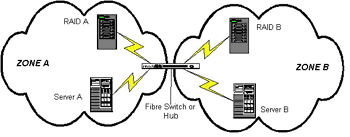
SAN zoning is a method of arranging Fibre Channel devices into logical groups over the physical configuration of the fabric. SAN zoning may be utilized to implement compartmentalization of data for security purposes. Each device in a SAN may be placed into multiple zones. Hard and Soft Zoning Hard zoning is zoning which is implemented in hardware. Soft zoning is zoning which is implemented in software. Hard zoning physically blocks access to a zone from any device outside of the zone.

[ read more ]

iSCSI vs NAS

iSCSI vs NAS

iSCSI (Internet Small Computer System Interface) is an IP-based storage networking standard that allows users to access data stored on a remote server from a number of computers within a specific network by linking computers over the Internet. It transfers data over local area networks, wide area networks, and the Internet. iSCSI places a shortcut on the user's computer in order to provide the illusion that a user is storing data on his/her computer while the data is actually stored and retrieve

[ read more ]

World Wide Name (WWN)

World Wide Name (WWN)

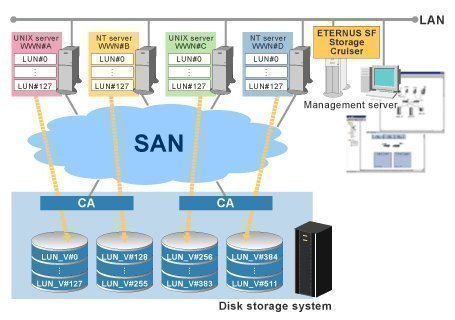
A World Wide Name, or WWN, is a 64-bit or 128-bit name assigned to each manufacturer of network storage devices and fiber channels by the Institute of Electrical and Electronics Engineers, or IEEE. Each network storage device that a manufacturer produces must include the manufacturer’s WWN, which is used to identify a network storage device on a Storage Area Network, or SAN.   World Wide Name Vs Mac Address World Wide Names are similar to Mac Addresses, but are formatted differen

[ read more ]

SAN (Storage Area Network)

SAN (Storage Area Network)

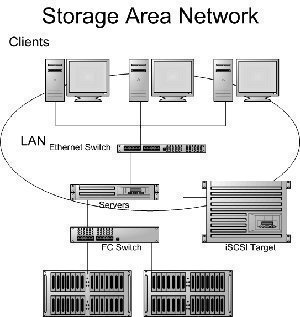
A SAN (Storage Area Network) is a network specifically dedicated to the task of transporting data for storage and retrieval. SAN architectures are alternatives to storing data on disks directly attached to servers or on Network Attached Storage (NAS) devices that are connected through general purpose networks. In order to meet the storage system's demands, enterprises apply SAN to increase the system efficiency and capacity expansion. According to SNIA (Storage Networking Industry Association

[ read more ]

Network Attached Storage

Network Attached Storage

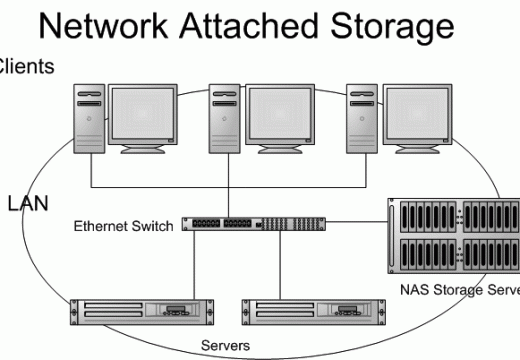
Network Attached Storage (NAS) is a term used to describe a complete storage system which is designed to be attached to a traditional data network. This differentiates Network Attached Storage devices from SAN's (Storage Area Networks). A SAN is a separate network to which storage devices are attached. In most cases, Network Attached Storage is less expensive to purchase and less complex to operate than a Storage Area Network. However, a SAN can provide better performance and a larger ran

[ read more ]

Page 1 of 212