

The Kelvin Scale is a thermometric scale used in physical science to describe the absolute temperature of an object, substance, or area. While Fahrenheit and Celsius scales measure temperature, the Kelvin Scale defines temperatures relative to an object’s thermodynamic movement. As a result, the Kelvin Scale does not use degrees, but simply a number followed by “K” for Kelvin. The Kelvin Scale begins at absolute zero (equivalent to -273.15° C), which is the temperature at which all objects stop moving, and ends at the triple point of water (equivalent to 0.01°C), which is the temperature at which water exists in all three states of matter simultaneously.
How the Kelvin Scale Works
British physicist, William Thomson (1st Baron Kelvin) invented the Kelvin Scale. The Kelvin Scale describes how fast an object is moving in reference to thermodynamics. If the object is not moving at all and does not give off any heat, the object is measured as 0 K. At the triple point of water, however, an object is measured as 273.16 K. Although this marks the end of the traditional Kelvin Scale, it can measure any temperature and defines how fast an object’s individual particles are moving. As a result, the Kelvin Scale is used to measure the temperature of objects like stars, black holes, and space regions.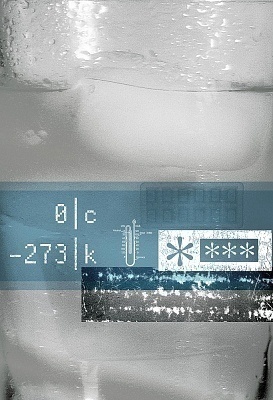
Applications
The Kelvin Scale is typically used for two purposes. It primarily measures temperatures relative to absolute zero. For this purpose, the Kelvin Scale measures stars, planets, black holes, galaxies, space regions, specific locations on Earth, nuclear explosions, and is used in cryogenics. The Kelvin Scale is secondarily used to determine light’s intensity based on its individual colors. This is also referred to as color temperature. That is to say, the Kelvin Scale measures a flame’s temperature based on the colors that the flame produces.
Advantages
The Kelvin Scale begins at absolute zero and provides the object’s actual temperature rather than a measurement relative to a secondary temperature. As a result, the Kelvin Scale is much more practical for measuring extremely hot or cold temperatures, such as those found in space or in exotic environments.
Follow Us!