

A permanent magnet (ferromagnet) is a material that produces a magnetic field. Permanent magnets are made from ferromagnetic materials, such as iron, and are created when the material is placed inside of a magnetic field. When the magnetic field is removed, the object remains magnetized. Permanent magnets have a permanent magnetic field and do not turn on and off like electromagnets do. Permanent magnets are the oldest type and are still used for a wide variety of applications today.
How Permanent Magnets Work
Permanent magnetization of a material involves its electrons and how they move around their nucleus. In most materials, electrons move in a rather spontaneous manner. In a ferromagnetic material, however, electrons align themselves and spin in the same direction while orbiting their nucleus. This produces a small magnetic field. As more electrons align themselves, the magnetic field becomes stronger. In the case of permanent magnets, electrons tend to stay aligned, unless heated above the Curie temperature and then cooled.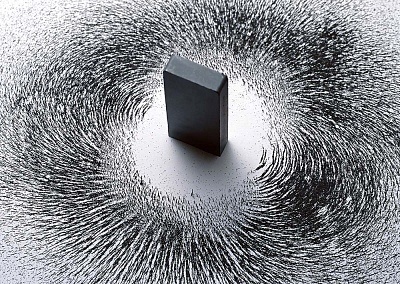
Applications
Permanent magnets represent the majority of magnetic materials and are used in a variety of ways. For example, permanent magnets are often attached to gears or shafts to be used in conjunction with an electromagnet inside of a motor. In fact, this is the basis of every electromechanical device in the world. Permanent magnets are often used on refrigerators to hold paper and other light objects to the metal surface. Permanent magnets are also used to keep cabinets and other doors closed that must be accessed frequently.
Advantages
Permanent magnets have several advantages that electromagnets do not. For example, permanent magnets do not require any power source and usually produce a powerful magnetic field compared to their size. Contrastingly, electromagnets must be continuously connected to a power source that may be quite large depending on the magnetic field needed.
Disadvantages
Although permanent magnets are advantageous, they do have several disadvantages. For example, permanent magnets constantly produce a magnetic field and cannot be turned off like electromagnets. Likewise, it is not easy to control the intensity of a permanent magnet’s magnetic field. Furthermore, permanent magnets do not usually have a very large magnetic field, a property that makes it difficult to use them over long distances.
Follow Us!