

There are a number of vibration sources throughout the world. In most cases, these movements have undesirable effects on things used in daily life, such as buildings and vehicles. Vibration isolators reduce or eliminate the effects of vibrations on equipment and structures. These devices are commonly referred to as shock mounts, snubbers, machine mounts, and Faraday cages (in the semiconductor industry). Vibration isolators are made from various materials, depending on their function. Some of these materials include rubber, metal alloys, neoprene, and fiberglass.
How do Vibration Isolators Work?
Most vibration isolators can be classified as either passive or active vibration isolation systems. The passive system is typically a variation on the spring and damper design. A spring or spring-like substance softens vibrations and uses a damper to terminate the vibration that has disturbed the system. A classic example of a passive vibration isolator is the shock absorber on a car. Shock absorbers absorb the majority of the impact that a vehicle experiences when driving over a bump or rough terrain, resulting in a smoother ride for the passengers and less vibration transfer to the equipment in the car. The active vibration isolator uses an accelerometer and electromagnetic drivers to achieve a greater degree of vibration isolation for the entire system than a passive isolator can achieve by providing feedback to the device.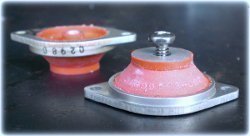
Types of Vibration Isolators
Several types of vibration isolators are used today. Springs were one of the first isolators used and are still used to some degree. The spring absorbs the vibration and then releases it in a different direction. Rubber was the second most used substance for isolating vibrations. Rubber is similar to springs in that it absorbs and releases energy in a different direction . Oil was also used in some systems, but acted more like a vibration damper as it absorbed some of the overall vibration energy in the system. Foam and Polyurethane were more recently used to isolate vibrations since they can both isolate and dampen vibrations. Unfortunately, foam breaks down fairly quickly and polyurethane does not have much flexibility. There are also a number of new products being produced that build on Polyurethane’s strengths, which can both isolate and dampen while displaying rubber-like qualities.
Jeff Myers
This is a good post, very detailed and insightful. However, I’ve actually found a number of companies, primarily in the medical and science fields that offer custom designed vibration isolation solutions to fit varying needs..
http://www.vistekinc.com/passive-vibration/passive-vibration-isolation-overview