

Transconductance is a property of some electronic components and is also known as mutual conductance. It is the opposite of resistance. The measure of transconductance is the ratio of the electrical current change at an output port as compared to the voltage change at the input port. The measure of transconductance is commonly used in reference to vacuum tube ratings as well as other electronic devices.
Devices With Measurable Transconductance
Vacuum tubes, bipolar transistors, field effect transistors, and amplifiers typically have a measurable transconductance value. In vacuum tubes, it is the change of the plate or cathode current divided by the change in the cathode voltage. The typical value for transconductance in a vacuum tube is between one and 10 millisiemens. In a field effect transistor, transconductance is measured as the change in the source current divided by the change in the source voltage, with typical measurements being between one and 30 millisiemens. In a bipolar transistor, the property is measured between one and 400 millisiemens and the measurement is proportional to the collector current. In an amplifier, the current output is proportional to the input voltage and is considered a voltage controlled current source.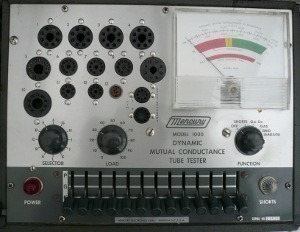
813 Vacuum Tube Specification
Although vacuum tube technology is dated, it is still widely used throughout industry in traditional equipment. This technology uses a glass tube that is almost completely inert, which forces current to move in a single direction. This is a critical component of converting Alternating Current (AC) to Direct Current (DC) in a radio set. RCA designed the 813 vacuum tube in the 1950s and it is still produced for HF amateur radio sets today. The 813 vacuum tube uses a thoriated tungsten filament to which a small amount of thorium is added. This helps it to produce electrons in a more efficient manner. The 813 vacuum tube works on 10 volts and has a transconductance rating of 3750 micro-ohms. The greater the transconductance, the greater the amount that the 813 vacuum tube can amplify.

Follow Us!