QPSK (Quadrature Phase Shift Keying)
QPSK (Quadrature Phase Shift Keying) is a phase modulation algorithm. Phase modulation is a frequency modulation version where the carrier wave’s phase is modulated to encode bits of digital information in each phase change. The “PSK” in QPSK refers to the use of Phased Shift Keying. Phased Shift Keying is a form of phase modulation that is accomplished by using a discrete number of states. QPSK refers to PSK with 4 states. With half that number of states, there is a BPSK (Binary Phased Shift Keying). With twice the number of states as QPSK, there is a 8PSK. The “Quad” [...]
Quadrature Amplitude Modulation
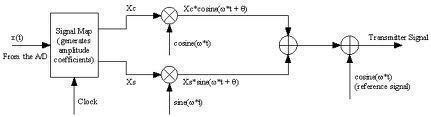
Quadrature Amplitude Modulation (QAM) is a complicated name for a simple technique. In the simplest of terms, Quadrature amplitude modulation is the combination of amplitude modulation and phase shift keying. More technically, quadrature amplitude modulation is a system of modulation in which data is transferred by modulating the amplitude of two separate carrier waves, mostly sinusoidal, which are out of phase by 90 degrees (sine and cosine). Due to their phase difference, they are called quadrature carriers. Unmodulated signals exhibit only two positions enabling a transfer of either a 0 or 1. In quadrature amplitude modulation, it is possible to [...]
Symbol Rate
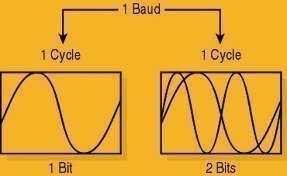
The symbol rate is the rate of state changes on a communications circuit. If a circuit can carry two tones per second, the circuit has a symbol rate of two. Circuits then use different modulation techniques to carry multiple bits per symbol. If the circuit is limited to two different tones, the first tone can represent a 0 and the second tone can represent a 1. In this circuit, the symbol rate is the same as the bit rate. If the circuit can carry four different tones, then the tones can be used to encode twice as many bits per [...]
FSK (Frequency Shift Keying)
FSK (Frequency Shift Keying) is also known as frequency shift modulation and frequency shift signaling. Frequency Shift Keying is a data signal converted into a specific frequency or tone in order to transmit it over wire, cable, optical fiber or wireless media to a destination point. The history of FSK dates back to the early 1900s, when this technique was discovered and then used to work alongside teleprinters to transmit messages by radio (RTTY). But FSK, with some modifications, is still effective in many instances including the digital world where it is commonly used in conjunction with computers and low [...]