

Before you ask what an LNB tester is, you should know what an LNB is. An LNB is the receiving end of a satellite dish. LNB stands for low noise blocker; it is a device that essentially does what it says. It blocks low noise (frequencies) in order to receive higher frequencies in which satellite transmissions use. Today, the majority of satellite dishes are sold for commercial use to receive digital television signals or for communication technology such as broadband Internet.
Low noise blockers also amplify the high end frequencies that they receive. Usually a LNB will be located at the end of the arm on a satellite dish. Generally speaking, satellites include a single RF output for the connection of an RG-6 coaxial cable that usually goes straight into the home and connects to various satellite TV receivers. Many satellite dishes now include dual LNB’s. A dual output LNB is able to distribute satellite signals to more than just one receiver so you can watch different TV shows on separate TV sets in a home.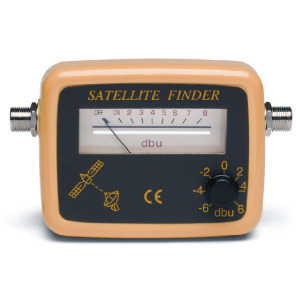
LNB Testers
Low noise blocker testers are generally used in the installation phase or when a satellite dish must be realigned. When you initially install an LNB, the satellite dish and LNB, must be pointed at a certain location up towards the sky. This is determined by the path of the satellite overhead. For instance, many satellite dishes must point North in order to receive signals and the angle that they point in is extremely important.
Because a satellite dish and its LNB location on the ground is extremely important many people use an LNB tester to survey an area to make sure that a satellite dish is properly aligned and able to receive specific signals. The alignment of the dish and LNB must be aligned precisely to the satellite’s direction in order to make sure that it is perfectly installed to receive the best signals possible.
How LNB Testers Work
LNB testers work on the premise of finding the strongest signal strength. Most LNB testers are extremely sensitive. Most LNB testers include an analog meter that clearly displays readouts of signal strengths. Digital readouts are also available on many LNB testers.
Many LNB testers will test for frequencies in the ranges that vary from 950 to 2050 MHZ. Usually the signals that your LNB receive will fall within this range. Not only does an LNB locate signals from 950 to 2050 MHZ, but it will also tell you the strength of these signals. Most LNB testers can detect the strength of satellite signals from a range of about -40 to-80 dBm.
In order to test for satellite signals, usually testers will be connected between the LNB and satellite receiver. Most LNB connectors have one input that receives signals from the LNB and an output that then sends the signals to the satellite receiver. Usually LNB testers are powered by the satellite receiver, however many testers do come with a jack for an auxiliary power source. Once your LNB tester is connected between the LNB and satellite receiver, you can then determine if a satellite signal is available and ultimately the strength of the signal. Most satellite dish installers use the LNB tester to find the best location and alignment for your satellite dish so that your LNB is able to receive the strongest satellite signal possible.
Usually it takes only a few minutes at most to install an LNB tester and they are extremely easy to use. You can find many LNB testers for less than $50. These testers are light weight (usually weighing less than a pound) and only a few inches in length and width.

Muawia Hamouda
Can we use the AVOmeter to pick up the signal from the satellite without using a V or a receiver?
If it is possible, How do we do that? And what are the needed measurements from volts or ohms?
Will.Spencer
You can “pick up” the signal, but you can’t do much more than measure it’s strength. It’s not really about Volts and Ohms, it’s about dBm.