Tech-FAQ Tip: Click Here to Check for PC Errors

What is Low Earth Orbit?


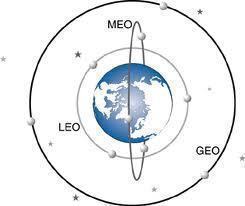
Low Earth Orbit (LEO) refers to a satellite which orbits the earth at altitudes between (very roughly) 200 miles and 930 miles.

Low Earth Orbit satellites must travel very quickly to resist the pull of gravity -- approximately 17,000 miles per hour. Because of this, Lowe Earth Orbit satellies can orbit the planet in as little as 90 minutes.

Low Earth Orbit satellite systems require several dozen satellites to provide coverage of the entire planet.

Low Earth Orbit satellites typically operate in polar orbits.

Low Earth Orbit satellites are used for applications where a short Round Trip Time (RTT) is very important, such as Mobile Satellite Services (MSS).

Low Earth Orbit satellites have a typical service life expectancy of five to seven years.
Books on Low Earth Orbit Satellites

A Performance Analysis of a Low Earth Orbit Satellite System
This thesis provides a performance analysis of the TELEDESIC Low Earth Orbit Satellite System. It analyzes the system's performance to meet the real-time communications constraints with a full satellite constellation. Computer simulation results are the sources to evaluate delays associated with packets transmitted from source to destination earth stations. The simulation isrun at low, medium and high loading levels with two different, uniform and non- uniform, traffic distributions. The evaluated results are end-to-end packet delays and packet rejection rate. The results show that the TELEDESIC satellite system network is capable of meeting the real-time communication requirements with delay values much smaller than 400 ms.
A Performance Analysis of the IRIDIUM Low Earth Orbit Satellite System
This thesis provides a performance evaluation of the IRIDIUM Low Earth Orbit Satellite system. It examine's the system's ability to meet real time communications constraints with a degraded satellite constellation. The analysis is conducted via computer simulation. The simulation is run at low, medium, and high loading levels with both uniform and non-uniform traffic distributions. An algorithmic approach is used to select critical satellites to remove from the constellation. Each combination of loading level and traffic distribution is analyzed with zero, three, five and seven non-operational satellites. The measured outputs are ene-to-end packet delay and packet rejection rate. In addition to the delay analysis, a user's ability to access the network with a degraded satellite constellation is evaluated. The average number of visible satellites, cumulative outage time, and maximum continuous outage time are analyzed for both an Equatorial city and a North American city. The results demonstrate that the IRIDIUM network is capable of meeting real-time communication requirements with several non-operational satellites. Both the high loading level and the non-uniform traffic distribution have a significant effect on the network's performance. The analysis of both network delay performance and network access provides a good measure of the overall network performance with a degraded satellite constellation.
A Numerical Study of Fuel-Optimal Low-Earth-Orbit Maintenance
This thesis studies the fuel optimal periodic reboost profile required to maintain a spacecraft experiencing drag in low-earth-orbit (LEO). Recent advances in computational optimal control theory are employed, along with a Legendre-Gauss-Lobatto Pseudospectral collocation code developed at the Naval Postgraduate School, to solve the problem. Solutions obtained by this method are compared against a previous study. Key issues were checking the optimality of the solutions by way of the necessary conditions and the behavior of the solution to changes in the thruster size. The results confirmed Jensen's findings of propellant savings of one to five percent when compared against a middle altitude Forced Keplerian Trajectory (FKT). Larger savings are predicted if compared against a finite-burn Hohmann transfer with drag. The costates estimates compared favorably against necessary conditions of Pontryagin's Minimum Principle. Analysis of the switching flinction yielded periods of thrust-modulated arcs. The optimal thrust profile appears to be a thrust- modulated burn to raise the orbit followed by an orbital decay and a terminating thrust-modulated arc. For a sufficiently low thrust-control authority, the switching structure includes a maximum thrust arc. Indirect optimization techniques to confirm these findings were unsuccessful.
Survivability Analysis of the Iridium Low Earth Orbit Satellite Network
This thesis evaluates the survivability of the proposed Iridium Low Earth Orbit (LEO) Satellite Network. In addition to the complete Iridium constellation, three degraded Iridium constellations are analyzed. This analysis occurs via the use of simulation models, which are developed to use three dynamic routing algorithms over three loading levels. The Iridium network models use a common set of operating assumptions and system environments. The constellation survivability was determined by comparing packet rejection rates, hop' counts, and average end to end delay performance between the various network scenarios. It was concluded that, based on the established scenarios, the proposed Iridium constellation was highly survivable. Even with only 45 percent of its satellites functioning (modeled with 36 failed Iridium satellites), the average packet delays were never greater than 178 milliseconds (msec), well within the real time packet delivery constraint of 400 msec. As a result, while additional research is necessary, Iridium has demonstrated the network robustness that is required within the military communications environment.
A Model to Predict Diffraction Attentuation Resulting from Signal Propagation Over Terrain in Low Earth Orbit Satellite Systems
This study focused on multipath communication propagation impairments to the LEOSAT communications channel. Two terrain diffraction models, based on the geometric theory of diffraction (GTD), were developed and applied to the space-to-ground communications channel. These models were used to predict the impact of terrain on the performance of three LEOSAT communication systems with designs based on the Iridium, Globalstar and Orbcomm implementations. The study verified the feasibility of applying models based on the GTD rather than empirical or statistical models, to approximate the effect of propagating signals over terrain. Both models confirm that signal blockage and multipath propagation, due to terrain diffraction, can be significant considerations for designers and users of such systems.
Performance Analysis of Dynamic Routing Protocols in a Low Earth Orbit Satellite Data Network
Modern warfare is placing an increasing reliance on global communications. Currently under development are several Low Earth Orbit (LEO) satellite systems that propose to deliver voice and data traffic to subscribers anywhere on the globe. However, very little is known about the performance of conventional routing protocols under orbital conditions where the topology changes on a scale of minutes rather than days. This thesis compares two routing protocols in a LEO environment. One (Extended Bellman-Ford) is a conventional terrestrial routing protocol, while the other (Darting) is a new protocol which has been proposed as suitable for use in LEO networks. These protocols are compared via computer simulation in two of the proposed LEO systems (Globalstar and Iridium), under various traffic intensities. Comparative measures of packet delay, convergence speed, and protocol overhead are made It was found both protocols were roughly equivalent in end-to-end delay characteristics, though the Darting protocol had a much higher overhead load and demonstrated higher instability at network update periods. For example, while steady state end-to- end delays were within a few milliseconds, in one case Darting showed an increase of 764% in convergence time over Extended Bellman-Ford with an increase of 149% in overhead. Over all cases, Darting required an average of 72.1% more overhead than Extended Bellman-Ford to perform the same work. Darting was handicapped by its strong correlation between data traffic and protocol overhead. Modifications to reduce this overhead would result in much closer performance.
A Performance Analysis of Dynamic Routing Algorithms in an IRIDIUM-Like Low Earth Orbit Satellite System
This research presents a first of its kind comparative analysis of the Extended Bellman-Ford and Darting algorithms, using the Iridium low earth orbit (LEO) satellite system configuration for the simulation environment. The algorithms are compared to one another via discrete-event computer simulation and evaluated based on their ability to route real-time voice communications under low, medium, and high network loading conditions. The algorithms' ability to meet real-time voice constraints is evaluated with a full and degraded satellite constellation using an algorithmic satellite removal method. The investigation results indicate that both algorithms are suitable for use in a LEO environment and are capable of meeting the real-time voice communications requirements as long as a load-balancing mechanism is in place to route traffic around heavily loaded satellites. The results also indicate that the Iridium system is robust, capable of meeting the real-time voice constraints even when the constellation is degraded.
Performance Analysis of Protocol Independent Multicasting-Dense Mode in Low Earth Orbit Satellite Networks
This research explored the implementation of Protocol Independent Multicasting - Dense Mode (PIM-DM) in a LEO satellite constellation. PIM-DM is a terrestrial protocol for distributing traffic efficiently between subscriber nodes by combining data streams into a tree-based structure, spreading from the root of the tree to the branches. Using this structure, a minimum number of connections are required to transfer data, decreasing the load on intermediate satellite routers. The PIM-DM protocol was developed for terrestrial systems and this research implemented an adaptation of this protocol in a satellite system. This research examined the PIM-DM performance characteristics which were compared to earlier work for On- Demand Multicast Routing Protocol (ODMRP) and Distance Vector Multicasting Routing Protocol (DVMRP) - all in a LEO satellite network environment. Experimental results show that PIM-DM is extremely scalable and has equivalent performance across diverse workloads. Three performance metrics are used to determine protocol performance in the dynamic LEO satellite environment, including Data-to- Overhead ratio, Received-to-Sent ratio, and End- to-End Delay. The OPNET(registered) simulations show that the PIM-DM Data-to- Overhead ratio is approximately 80% and the protocol reliability is extremely high, achieving a Receive-to-Sent ratio of 99.98% across all loading levels.


Bookmark What is Low Earth Orbit?

Latest Blog Posts


Copyright 2008 Tech-FAQ. All rights reserved.