

QPSK (Quadrature Phase Shift Keying) is a phase modulation algorithm.
Phase modulation is a frequency modulation version where the carrier wave’s phase is modulated to encode bits of digital information in each phase change.
The “PSK” in QPSK refers to the use of Phased Shift Keying. Phased Shift Keying is a form of phase modulation that is accomplished by using a discrete number of states. QPSK refers to PSK with 4 states. With half that number of states, there is a BPSK (Binary Phased Shift Keying). With twice the number of states as QPSK, there is a 8PSK.
The “Quad” in QPSK refers to four phases in which a carrier is sent in QPSK: 45, 135, 225, and 315 degrees.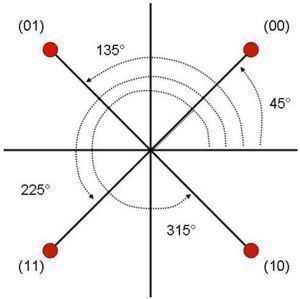
QPSK Encoding
Because QPSK has 4 possible states, QPSK can encode two bits per symbol.
Phase Data 45 degrees Binary 00 135 degrees Binary 01 225 degrees Binary 11 315 degrees Binary 10
QPSK is more tolerant of link degradation than 8PSK, but does not provide as much data capacity.
Max
wrong representation of qpsk encoding ac to phase
Asmita Roy
What are the different parameters that change according to the change of modulation techniques?
vinoth
Hi the $5 deg equilent binasry is 2b1001 like that how i calculate cau help me plz
Jonna
@Shaitan
Get matured soon. You are still a kid, learn to be a human from good people.
Shaitan
Google pe daal mil jayega einstien ki olaad!!
aasad
phudi kai why you even here?