Symbol Rate
The symbol rate is the rate of state changes on a communications circuit.
If a circuit can carry two tones per second, the circuit has a symbol rate of two.
Circuits then use different modulation techniques to carry multiple bits per symbol.
If the circuit is limited to two different tones, the first tone can represent a 0 and the second tone can represent a 1. In this circuit, the symbol rate is the same as the bit rate.
If the circuit can carry four different tones, then the tones can be used to encode twice as many bits per symbol. In this circuit, the bit rate is now twice the symbol rate.
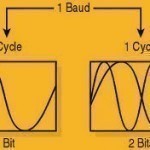
Using more tones allows more bits per second (bps) to be squeezed out of every symbol, but this also requires higher quality circuits. If the circuit is not high enough quality, the number of retransmissions will cause the circuit to be slower than with a lower number of tones.
The choice of how many tones to use is determined by the modulation algorithm chosen. QPSK uses four tones, 8PSK uses eight tones.
The use of 4 tones is standard in the satellite world. In the cable television world, the higher quality transmission medium enables 64QAM modulation to be the standard.
Symbol Rate is abbreviated as SR.
The symbol rate is also known as the baud rate.

- 8PSK
8PSK (8 Phase Shift Keying) is a phase modulation algorithm. Phase modulation is a version of frequency modulation where the phase of the carrier wave is modulated to encode bits of digital information in each phase change. The “PSK” in 8PSK refers to the use of Phased Shift Keying. Phased Shift Keying is a form [...]...
- cannot resolve symbol
“cannot resolve symbol” means that the Java compiler cannot locate a symbol referenced in your Java source code. The causes for this common error include: A missing class file A faulty CLASSPATH A symbol name is mispelled or miscapitalized A data type is incorrect, misspelled, or miscapitalized A method is called with the wrong number [...]...
- QPSK (Quadrature Phase Shift Keying)
QPSK (Quadrature Phase Shift Keying) is a phase modulation algorithm. Phase modulation is a frequency modulation version where the carrier wave’s phase is modulated to encode bits of digital information in each phase change. The “PSK” in QPSK refers to the use of Phased Shift Keying. Phased Shift Keying is a form of phase modulation [...]...
- Refresh Rate
The Refresh rate is the number of times a display's image is repainted or refreshed per second. As it denotes a frequency of a process, the refresh rate is expressed in hertz. That is, a refresh rate of 75 Hz means the image is refreshed 75 times in one second. For academic interest, it should [...]...
- Quadrature Amplitude Modulation
Quadrature Amplitude Modulation (QAM) is a complicated name for a simple technique. In the simplest of terms, Quadrature amplitude modulation is the combination of amplitude modulation and phase shift keying. More technically, quadrature amplitude modulation is a system of modulation in which data is transferred by modulating the amplitude of two separate carrier waves, mostly [...]...