

LAN Segmentation Overview
Network segmentation is the terminology used to describe the process of dividing single Ethernet segments into
multiple segments.
Network segmentation has the following main advantages:
-
Network performance of the LAN is improved.
-
Network congestion issues can be resolved.
-
Available bandwidth is maximized.
A few technologies which you can use to perform network segmentation are listed here:
-
The network can be physically segmented with bridges and routers. This type of segmentation directly
decreases the number of workstations on the same physical segment.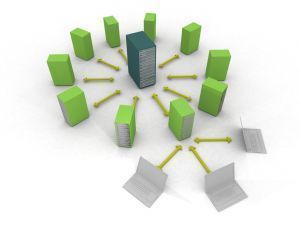
-
You can use a network switching technology to provide LAN segmentation features. LAN switches can assist in
increasing bandwidth availability for workstations because LAN switches support simultaneous switching of packets
between the ports in the switch. -
Full-duplex Ethernet can be used to alleviate congestion and to provide about two times more bandwidth than
that available with Ethernet networks. In full-duplex mode, flow control is used for the communication session. The
nodes can send and receive data at the same time. You do however need to ensure that the switch port and the network
interface cards can operate in full-duplex mode. -
You can use Fast Ethernet devices. Fast Ethernet takes about 90 percent less time than what 10 Mbps Ethernet
requires to send the identical frame. Through faster speed, Fast Ethernet increases capacity.
A few features of Ethernet LAN segmentation are listed here:
-
Distance limitations are no longer an issue.
-
Traffic can be confined to different segments.
-
Collisions and latency are decreased
-
The impact of broadcasts and multicasts are lessened.
-
Throughput is improved.
-
Bandwidth availability per user is increased.
Segmenting LANs using Routers
Routers operate at the Network layer of the OSI reference model to route data to remote destination networks.
Routers use Routing table information to make routing decisions. The Routing table contains information on how the
remote destination networks can be reached. Information on reaching specific hosts is not kept in the Routing table.
Cisco routers maintain a Routing table for each network protocol. This means that one Routing table is maintained for
IP, another is maintained for IPX, and yet another Routing table is maintained for AppleTalk.
Using routers can be considered as being a better option than using bridges. While bridges filter by MAC address,
routers filter by IP address. Bridges forward a packet to all segments that it is connected to. Routers on the other
hand only forward the packet to the particular network segment that the packet, is in fact, intended for.
With reference to Ethernet LAN segmentation, the main features of routing are summarized here:
-
The default configuration is that the router does not forward broadcasts and multicast frames.
-
Routers require of the functions provided by the Layer 3 protocols.
-
Routers use Layer 3 headers and logic to perform routing of packets.
-
Routers typically perform more functions before a packet is routed. This in turn results in latency.
-
Routers utilize the store-and-forward logic which results in more latency than a single LAN segment. The whole
packet has to be received before it is forwarded.
The benefits of segmenting LANs using routers are listed here:
-
Routers are more complex and software-intensive than bridges.
-
Distance limitations are no longer an issue because each segment can be created with the maximum distance for the
specific Ethernet type. -
Routers also prevent unnecessary network traffic from being sent over the network.s segments. Routers only forward
the packet to the particular network segment that the packet is intended for. -
Using multiple routing protocols can provide quite some flexibility in terms of creating the internetwork.
-
A router does not forward frames between devices located on the same segment. This in turn decreases
collisions. -
Routers do not forward broadcasts and multicasts, thereby decreasing the impact of broadcasts/multicasts. Routers
tend to contain broadcasts to localized broadcast domains . they do not forward broadcasts like switches and bridges
do. -
Each segment runs at 10 or 100 Mbps, which in turn increases total bandwidth.
-
When routing packets, routers make informed routing decisions. The routing protocol defined on the router, path
metrics, and source service access points (SSAPs) and destination service access points (DSAPs) are used to make these
informed routing decisions. -
Routers are also more informed on packet flows than a transparent bridge.
-
Routers can have multiple active links between devices.
-
Cisco routers provide additional functionality, such as:
-
Error control
-
Flow control
-
Congestion control
-
Packet lifetime control
-
Packet fragmentation and reassembly
-
Segmenting LANs using Bridges
Bridges work by regenerating signals. Bridges read the MAC address of a data frame to determine whether the
destination computer resides on the local segment or a different segment. Based on this determination, the bridge does
one of the following:
-
If the destination exists on the local segment, the frame is not forwarded out to all network segments to which it
is connected. -
If the destination does not exist on the local segment, the frame is forwarded out to all network segments
to which it is attached.
When segmenting LANs using bridges, broadcast storms can occur due to the broadcast packets propagating throughout
the network. This is typically caused by bridges forwarding frames out of all attached segments. Processing of frames
can also lead to a significant increase in latency.
Bridges are responsible for the following functions:
-
Checking the MAC addresses of frames when frames are received.
-
Using the destination MAC address, bridges determine when frames should be filtered and forwarded.
-
Bridges utilize the Spanning-Tree Protocol (STP) to create a loop-free environment with the other bridges.
With reference to Ethernet LAN segmentation, the main characteristics of using bridges are summarized
here:
-
Bridges forward broadcasts and multicast frames.
-
Bridges are not dependent on Layer 3 protocols.
-
Bridges use Layer 2 headers and logic to perform switching of packets.
-
Bridges utilize the store-and-forward logic which results in more latency than a single LAN segment. The whole
frame has to be received before it is forwarded. -
Bridges typically perform more functions before a packet is forwarded. This in turn results in latency.
The benefits of segmenting LANs using bridges are listed here:
-
Distance limitations are no longer an issue because each segment can be created with the maximum distance for the
specific Ethernet type. -
Each segment runs at 10 or 100 Mbps, which in turn increases total bandwidth.
-
For frames that has a source and destination on the same LAN segment, traffic can be contained in the specific LAN
segment. -
Because frames are filtered, collisions are decreased.
Segmenting LANs using Switches
With regard to LAN segmentation, Ethernet switching can perform all the functions that bridges perform. However,
switches provide more speed and strength than bridges. Another feature of switches is that they can operate in
full-duplex mode.
With reference to Ethernet LAN segmentation, the main features of using switches are summarized here:
-
Switches forward broadcasts and multicast frames.
-
Switches are not dependent on Layer 3 protocols.
-
Switches use Layer 2 headers and logic to perform switching of packets.
-
Switches utilize the store-and-forward logic and cut-through logic, which results in more latency than a single LAN
segment. The whole frame has to be received before it is forwarded. -
Switches typically perform additional functions before a packet is transmitted. This in turn results in
latency.
The benefits of segmenting LANs using switches are listed here:
-
Distance limitations are no longer an issue because each segment can be created with the maximum distance for the
specific Ethernet type. -
Each segment runs at 10 or 100 Mbps, which in turn increases total bandwidth.
-
Simultaneous frame forwarding can take place as well.
-
For frames that has a source and destination on the same LAN segment, traffic can be contained in the specific LAN
segment. -
When compared to a bridge, switches reduce latency. This is made possible by the hardware of switches being
optimized through fast switching. -
Cisco access lists can be used to control the flow of frames.
-
Because unicast frames are forwarded out from the correct port, collisions are decreased.
-
By using the Cisco Group Message Protocol (CGMP), switches can also limit the impact of broadcasts.
karthi
sir i am maintance simple network.same network have worked dy 20 no of system .that have one problam sir only one system have problam in network status is very receved data is less.sir my request is .how will receved the data is up sir