

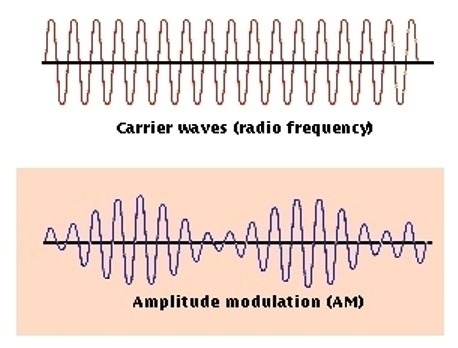
Amplitude modulation is a type of modulation where the carrier signal’s amplitude is varied in accordance with the information bearing signal.
The amplitude modulated signal’s envelope or boundary embeds the information bearing signal.
The total power of the transmitted signal varies with the modulating signal, whereas the carrier power remains constant.
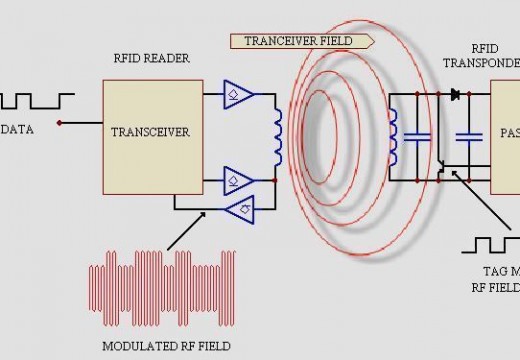
A nonlinear device combines the carrier and the modulating signal to generate an amplitude modulated signal. The nonlinear device’s output consists of discrete upper and lower sidebands.
A nonlinear device’s output does not vary in direct proportion with the input.
Amplitude Modulation is abbreviated AM.
narassen
Question
If a sinusoidal carrier wave of frequency 750 KHz and amplitude 4V is to be modulated by a sinusoidal signal of frequency 3kHz and amplitude 0.5 V. what will be the variation of amplitude of the modulated carrier wave?
please help!!
shailu
a type of modulation in which the amplitude of the carrier wave is varied above and beliw its unmodulated value by amount proportional to the amplitude of the signal wave and at the frequwncy of the modulation signal
hinal mehta
why only non-linear device can be used to combine carrier & modulating signle. and not the linear devices?
himanshu
why am signal can travel through long distances?
Sandeep
its not that AM only can travel long distance FM can also but AM signals travel by ground wave, diffracting around the curve of the earth over a distance up to a few hundred miles (or kilometers) from the signal transmitter. However, after sunset, changes in the ionosphere cause AM signals to travel by sky wave, enabling AM radio stations to be heard much farther from their point of origin than is normal during the day.This phenomenon can be easily observed by scanning an AM radio dial at night. As a result, many broadcast stations are required as a condition of license to reduce their broadcasting power significantly after sunset.
Mike
It is not the fact that the signal is AM or FM that determines the distance that they travel but the frequency it is transmitted at. Lower frequencies can use ground wave and are also affected more by the ionisation layers in the upper atmosphere giving large skip distances. AM has a narrower bandwidth than FM normally so is used more at the lower frequencies.