

A dual LNB (Low Noise Block-Down Converter) is an LNB system that features two outputs rather than one and allows satellite television subscribers to watch multiple channels on separate television sets simultaneously. Dual LNB systems use only one parabolic satellite dish, but have two cable connections that are connected to separate televisions in the user’s house. When the LNB collects television signals, it splits them into two equal signals that each television receives at the same time. Like dual LNB systems, triple and quadruple LNB systems are also available.
How LNBs Works
An LNB is used to convert high microwave frequencies that transfer television signals across long distances into low digital signals that can be transferred through a cable line. LNBs do this by running a voltage from the user’s receiver to power an oscillator found on the parabolic dish that produces a fixed frequency. This fixed frequency is then combined with the incoming frequency to produce two separate signals that equal the sum and the difference of the two frequencies respectively. The sum of the two frequencies is filtered out and the difference is redirected to the user’s receiver as a digital signal that is proportional to the original incoming microwave frequency.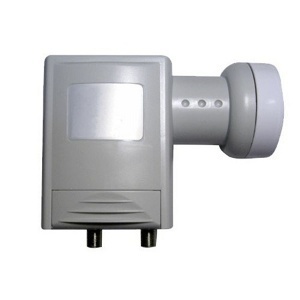
Applications
Both personal and commercial satellite television subscribers use dual LNBs to direct the same signals to multiple televisions sets, in much the same way cable television subscribers use multiple cables from the same line to watch different channels on separate televisions. Dual LNBs may also be required in environments in which a subscriber is dependent on a single satellite for both television and Internet services.
Advantages
Dual LNBs are advantageous because they provide subscribers with the same benefits that a regular LNB does, but also allow them to watch different channels on separate televisions. A dual LNB is no more complicated than a regular LNB as the system is connected directly to the parabolic dish and only requires the user to connect the appropriate cable to each television that he/she wishes to use.
Jacques Gerard Berube
What is the difference between dual lnb and monoblock lnb.
To receive HD, I need dual or monoblock and do I need 1 or 2 coaxial cables.
Thanks.
Jacques Gerard Berube
Shaka mhlabane
On the dual lnb, how do
I connect my signal finder between the two cables ?
Mensah Daniel
Can I use a dual LNB for two different decoders at the same time and it will work
Persuade
I’m failing to connect this twin lnb my decoder is saying No signal this may be due to bad weather or faulty connection in installation. please help
tonderai
I have one satellite dish but I want to use two different decoders, will also twin lnb allow me to connect 2 decoders from single dish.
Herman Voigt
Can you use a twin universal lnb for 2 separate decoders and subscribers?
Helper
Only if the Sat. Source is the same. You might need a Clip-On if the place in space you are trying to catch is close to the other
ken
yes, it is a go