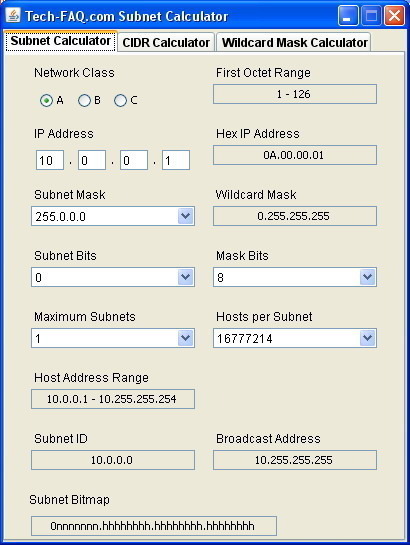
Subnet Calculator
Our subnet calculator which runs under Microsoft Windows so that it can be used even when you are disconnected from the Internet.
The subnet calculator supports both CIDR (Classless Internet Domain Routing) and wildcard masks.
To use this subnet calculator, you will need to install Java on your computer.
- Subnet Masks
A subnet mask allows users to identify which part of an IP address is reserved for the network and which part is available for host use. By looking at the IP address alone, especially now with classless inter-domain routing, users cannot tell which part of the address is which. Adding the subnet mask or netmask [...]...
- What is VLSM?
VLSM (Variable Length Subnet Mask) is a technique that network administrators employ in order to use their IP subnet(s) in a more effective manner. By using VLSM, a long mask can be used on a network that has a few hosts and a short net mask on subnets that have a large number of hosts. [...]...
- Subnetting
Subnetting is the process of breaking down an IP network into smaller sub-networks called “subnets.” Each subnet is a non-physical description (or ID) for a physical sub-network (usually a switched network of host containing a single router in a multi-router network). In many cases, subnets are created to serve as physical or geographical separations similar [...]...
- E-Voting
E-voting or electronic voting refers to any voting process where an electronic means is used for votes casting and results counting. E-voting methods include optical-scan voting systems, specialized voting systems like DRE or direct recording electronic voting systems, punch cards, national IDs, the Internet, computer networks, and telephony systems. Electronic voting is already in use [...]...
- Broadcast Address
A broadcast address is an IP address that targets all systems on a specific subnet instead of single hosts. The broadcast address of any IP address can be calculated by taking the bit compliment of the subnet mask, sometimes referred to as the reverse mask, and then applying it with a bitwise OR calculation to [...]...