

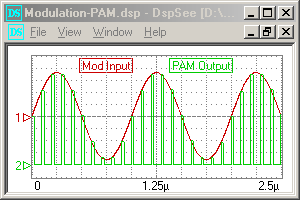
Pulse Amplitude Modulation (PAM) is the simplest form of pulse modulation. This technique transmits data by varying the voltage or power amplitudes of individual pulses in a timed sequence of electromagnetic pulses. In other words, the data to be transmitted is encoded in the amplitude of a series of signal pulses. PAM can also be used for generating additional pulse modulations.
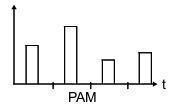
If you look at this from a purely theoretical standpoint, the possible pulse amplitudes in pulse amplitude modulation can be infinite. This is the case with analog pulse amplitude modulation. A 2 level pulse amplitude modulation causes the resulting signal to be digitized while a 4 level pulse amplitude modulation has 22 possible discrete pulse amplitudes. An 8-level pulse amplitude modulation has 23, and 16-level pulse amplitude modulation has 24 discrete pulse amplitudes.
Regarding various pulse amplitude modulation, some systems maintain the amplitude of each pulse directly proportional to the instantaneous modulating-signal amplitude at the time of pulse occurrence. In other pulse amplitude modulation systems, the reverse is true – that is, inversely proportional to the instantaneous modulating-signal amplitude at the time of pulse occurrence. In other pulse amplitude modulation systems, the amplitude is dependent on additional factors related to the modulating signal such as the instantaneous frequency and phase, which may be different than its strength.
However, in practical telecommunication applications, pulse amplitude modulation is a rare use technology, having been superceded by other techniques such as pulse position modulation and pulse code modulation. Additionally, a technology called quadrature amplitude modulation is widely used in telephone modems with a data transfer rate of more than 300 Kbps.
While newer technologies are fast making their presence known, it should be noted that pulse amplitude modulation is still useful in the popular Ethernet communication standard. For example, 100BASE-T2 – operating at 100Mb/s – Ethernet medium is using 5 level PAM modulations running at 25 mega pulses/sec over four wires. Later developments include the 100BASE-T medium which raised the bar to 4 wire pairs, running each at 125 mega pulses/sec in order to achieve 1000 Mbps data transfer rates, but still with the same PAM5 for each pair.
More recently, PAM12 and PAM8 have gained consideration in the newly proposed IEEE 802.3an standard for 10GBase-T — ten gigabyte Ethernet over copper wire.


swetha
Can you explain the PAM with a circuit of transistor…….i need to know how it is being modulated