

Pulse Width Modulation, abbreviated as PWM, is a method of transmitting information on a series of pulses. The data that is being transmitted is encoded on the width of these pulses to control the amount of power being sent to a load. In other words, pulse width modulation is a modulation technique for generating variable width pulses to represent the amplitude of an input analog signal or wave. The popular applications of pulse width modulation are in power delivery, voltage regulation and amplification and audio effects.
Pulse width modulation is used to reduce the total power delivered to a load without resulting in loss, which normally occurs when a power source is limited by a resistive element. The underlying principle in the whole process is that the average power delivered is directly proportional to the modulation duty cycle. If the modulation rate is high, it is possible to smooth out the pulse train using passive electronic filters and recover an average analog wave form.
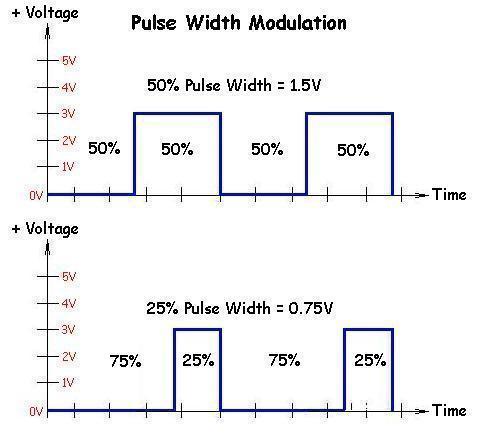
High frequency pulse width modulation power control systems can be realized using semiconductor switches. Here, the discrete ON or OFF state of the modulation itself can be used to control the switches, thereby controlling the voltage or current across the load. The major advantage with these types of switches is that the voltage drop across it during conducting and non-conducting states, is ideally zero. PWM's field of application includes Class D audio amplifiers, DC motor speed control, and light dimmers common in homes. Pulse width modulation is widely used in voltage regulators. It works by switching the voltage to the load with the appropriate duty cycle; the output will maintain a voltage at the desired level.
Pulse width modulation is also exploited in sound synthesis, especially subtractive synthesis, as the process gives a chorus effect or that of slightly detuned oscillators played together. Another application of PWM, as mentioned earlier, is the class D amplifiers, known for better audio clarity alongside its basic function – amplification. The class D amplifier produces a PWM equivalent of the input analog signal, which is in turn fed to the loud speaker after filtering out the carrier wave by sending it through a suitable filter network. Class D amplifiers are growing in demand owing to its better efficiency, lightweight, and cost. Also, due to the full on/off nature of PWM output, such amplifiers produce less heat than their conventional analog counterparts.
Mihir
Which is better from PAM,PWM,PPM FOR TRANSMISSION & WHY?
shan
which modulation is better between PAM,PWM,PPM?