

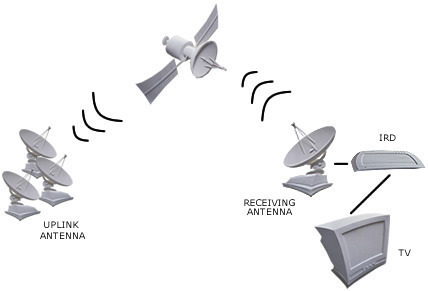
Satellite TV works by broadcasting video and audio signals from geostationary satellites to satellite dishes on the Earth’s surface.
These geostationary satellites orbit the earth in a region of space known as the Clarke Belt, which is approximately 22,300 miles above the equator.
Each of these satellites carries a number of transponders. These transponders each carry a signal back to the Earth.
These signals are typically on C Band, Ku Band, or Ka Band. The band of a signal describes, in broad terms, the frequency of the signal.
After travelling over twenty thousand miles, these signals are received by a satellite dish. This dish can be as small as 18″ across, or it can be 9′ or larger across. The purpose of the dish is to act as a collector and a reflector. The dish collects the signal and reflects it towards the feedhorn.
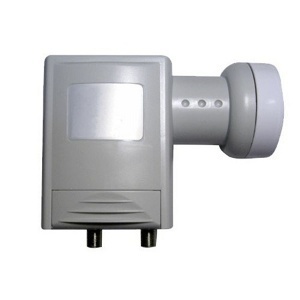
The feedhorn receives the reflected signal and sends it to the LNB. The LNB amplifies the signal and converts it to a frequency more suitable for transmission over a cable. In satellite terminology, that cable is known as the IFL.
The LNB transmits the signal over the IFL to the satellite receiver. The satellite receiver then sends the signal to your television set.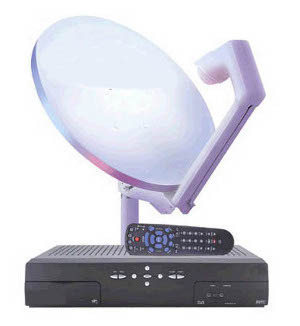
Digital Satellite TV
Most satellite TV is now encoded digitally. This enables satellite broadcasters to offer more television channels using the same amount of satellite bandwidth.
Satellite TV is available in both standard resolution and in the new ATSC High Definition (HDTV) format.
The digital data is usually compressed with MPEG-2 or a variation thereof. MPEG-4 is beginning to replace MPEG-2 in some satellite networks.
Satellite TV Options
Dozens of vendors operate satellite television networks across the globe. Your options for satellite TV will differ depending upon what country you live in. In addition, some spot beam services only serve specific large cities.
In the United States, the largest satellite TV vendors are Dish Network and DirecTV. Both DirecTV and Dish Network offer programming on the Ku and Ka bands.
In addition, National Programming Service and Superstar offer programming on C Band.
Some free-to-air satellite TV channels are even available at no cost if you have a Free-to-Air receiver.
Tony Latimer
My TV reception via Satelite from Imparja for the 9 Network is terrible, whilst 2,3 7 & 10 are generally much better. How ca I get this fixed?
maark
can i use 18”x20” dish from direct tv c band to transform in to FTA ku band with universal LNBF?
Dr. Deshmukh
I want to install a Satelite TV at home. How do I go about it. If I have a Dish provided by TATA SKY is this suitable or a separate Dish is needed.
ELIOT.COD
Counter UAV up, THEIR BLIND!
Butch please
They are*
khushbu
thanx for dis info i needed it for my school purpose it killed my curiosity 🙂
Nauman
i want to know how much it will cost if we launch dish tv in pakistan